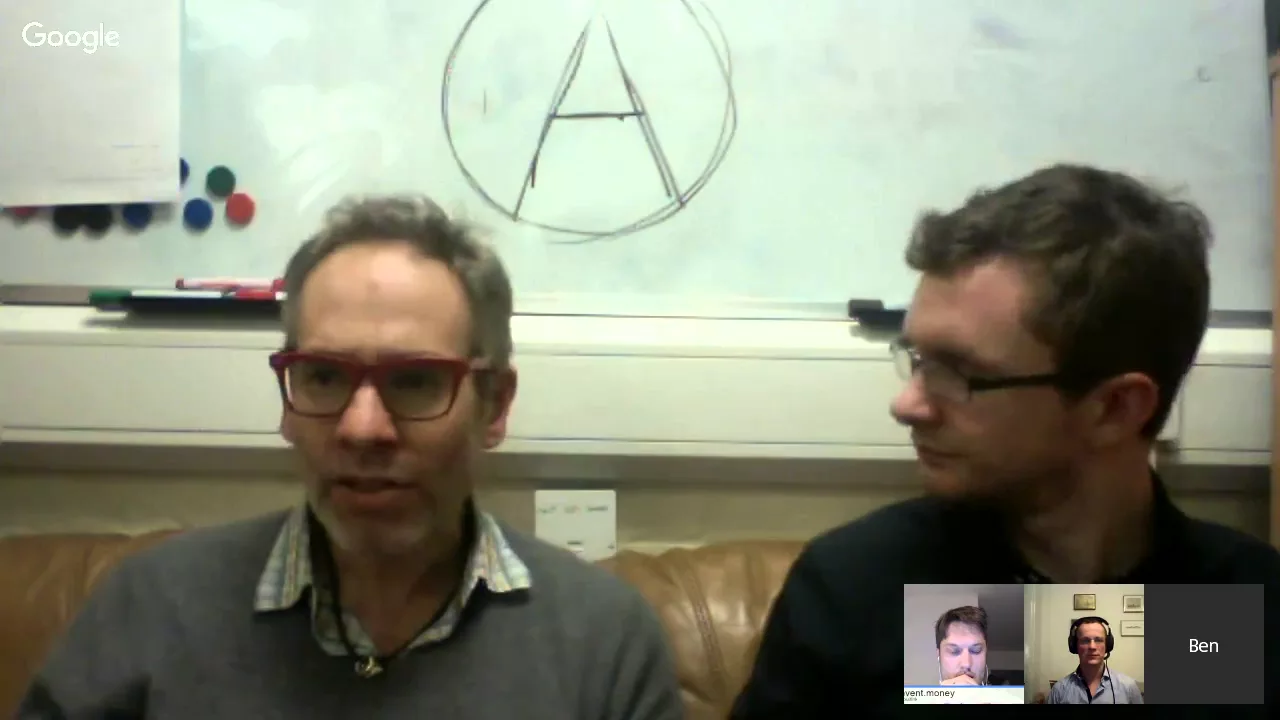
Who should create money? Positive Money, free markets and inequality
De Week van Bitcoin · January 2016 · 50:25
Ben Dyson of Positive Money and writer Dominic Frisby join host Paul Buitink and co-host Jan Willem Burgers for a friendly debate on who should create money. Dyson explains that banks create most money when they lend and that much of it flows into property and financial assets, and makes the case for state-issued money. Frisby, an anarchist, favours free-market alternatives. They argue that the current money system is the single biggest cause of inequality, and discuss quantitative easing.
Speakers
Topics
From De Week van Bitcoin; community: Reinvent Money.
Transcript
welcome to a new episode of the reinvent money show I'm your host Paul bouting and my co-host today is Young vien Burgers he's lecturer and philosopher at the V University in Amsterdam and he's also consultant over at coin and Company hi John hi guests today are writer comedian actor of unrecognized Genius voice of many things Financial bot and Anarchist Dominic frisbee domic hello hello hello I copied the line from your Twitter but uh totally agree with the description I you're also of course your latest book or latest books were about Bitcoin and life after State about Anarchy yeah I thorough really enjoyed those books and our other guest is uh
Ben Dyson sitting next to to donic and hi Ben Ben is frontman of the UK activist group positive money who wants to give the exclusive rights to print Fiat money to the government and today we're going to have an honest conversation about the pros and cons of purely State printed money and what Anarchy and competing currencies um is possibly a better deal so uh let's start the conversation um Ben um could you first uh explain to our viewers what positive money is all about and what kind of problem you're trying to sort with it yeah well we're we're looking at the connections between the banking system and the way the banking system works and the kind of big social and economic problems we have today so
things like household debt um the on affordability of houses uh inequality the financial crisis that we had in 2008 which is really still going on and um we trace a lot of these problems back to the same uh essentially root cause which is um as we see it it's the way that the banking system is able to create money um effectively out of nothing when they make loans um so I can explain that in a bit more detail if uh if you like uh yes I think would be good to explain it in a a little bit more detail so um if you if you ask people in the street you ask them the question where does money come from um and they'll probably tell you
it's the uh well depending which country you're in it's the bank of England it's the Federal Reserve the European Central Bank um It's usually the the National Bank of that country that people will say a lot of people I talk to still think we're on some kind of gold standard and we can only print as much money as there is gold and there's gold to back all the money that exists people still think that we're Way Beyond that we're Way Beyond the gold stand um it's amazing that some economy stuff um but so the the key thing is basically most money is not actually created by the government at all um when people are thinking about money they're usually thinking about paper money so that you know stuff you have in your pocket um
but the reality is 97% of money is just numbers in a computer system and N that 97% of all the money is actually cre by Banks yeah and the way Banks do this is is quite a simple accounting process when you go into a bank and take that loan um that money isn't coming from somebody else's life savings it's actually just simple accounting process and they they're effectively typing the N the money into the account so the vast majority of money is created when Banks make loans um opposite process well so when you pay a loan that money is effectively disappearing um Into Thin Air essentially yeah and that's and that specific uh thing is is for many people
a shock like the people think that Banks they takeing money and then they lend it out so they're like pure intermediary intermediaries but they actually create money when they issue a mortgage loan or any other type of loan and that's that's the the thing that um um that most people don't know right exactly exactly and you'd be surprised but a lot of economists don't really understand that either um and one uh an economist called their Turner who for about five years was the head of the UK's bank regulator the Financial Services Authority um he's he's given speeches where he said look if you look at the text box that they're teaching uh University students with today it tells you that a bank is there
to take money from sa and go and invest it in businesses and that's completely the wrong description of what banks do because firstly they don't take money from one place and lend it to somewhere else they actually create new money when they're lend it second most of that to business if they put it into the uh property market and the bank of England has has also confirmed that right that there is a lot of misinformation being spread in textbooks yeah I think that's a really important point is where this new money goes and these are your numbers but I mean so perhaps you should say them but only uh well you described so if you've got a the percentage breakdown of where
new money goes yeah so if you look at all of the money that the banks created in the 10 years before the financial crisis um so 1997 2007 the these are UK figures um about 51% of it went straight into property so uh Residential Mortgages and um Office Buildings basically um 31% went into the financial markets um so this could be uh trading financial markets trading Commodities Lage merges and Acquisitions yeah um derivatives all of this kind of stuff um 8% went to credit cards and Consumer loans um so to
buy cars and fridges and all that kind of thing um and it was only 8% that went to businesses outside of the financial sector one step back first um then I think we should talk about indeed where the money goes but just the educational thing because I had an interview today with um with a Dutch Professor Arnold here and he is basically the author of one of the most important Dutch economy books for um for high schools um for over four or five centuries the guy is 81 and he's still very much very active and he just published a new version of his book and I I read the part about money creation it was described perfectly um and I asked him has it been
like this for all these decades and he says yeah I always write it down like this and uh and he was basically in the in the 70s and the 80s he was the only um person basically providing the textbooks for Dutch high schools so I guess in Holland if if I if I'm if I'm Fair it it um it has been described in in the right way so is it more of a of a UK problem than than you think or is it because I I think it's important to make the distinction perhaps I was gonna say Paul just to to to add to what you just said I'm working on a new book about tax so I've been reading all sorts of histories of tax recently and exactly the problem that Ben described and that
your your gentleman that you interviewed described was going on 200 years ago in the Napoleonic Wars they still had the same problem that commercial Banks were creating money now it's it's manifested itself in in different ways now and more money gets created it's basically a perennial problem in banking yeah and and at least in Holland at least in this textbook it's been it's always been described well so but plus but he he did um recognize that quite a few authors and economists they know how it works but they think it's too too sort of difficult to to explain and that's why they use the intermediary model because it's sort of easier to convey the message in that way because the creation
process is a bit more tricky and you know dumbing down of Education a lot of professors they they choose the road of making this easiest possible for people to understand then by doing that they they make the they basically don't describe the situation well but I just wanted to make this qualification that um perhaps in UK it's worse than in Hollands yeah I think it's the same in the states as well it's basically um you speak to some of the older professors they'll tell you that in the 60s people you know understood money it was one of the first things they taught on courses and then in the 70s and the 80s basically this new wave of uh new economics um neoclassical uh or monist economics came
in but um a lot of these economists actually said money isn't that important because if you just put it into the economy it just causes inflation um that that's the only effect of money it doesn't actually affect what people do or how people live and the reality is that you can see how you know if all the money goes into property uh everybody jumps into the property Market housing becomes really expensive inequality increases um so I think we're moving now back towards people understanding that that money is a really important thing that affects so let's go back to your previous point that um that the way money enters into the economy it's it's it's very biased towards speculation and real estate yeah yeah exactly so that that's the majority of Bank lending now the
majority of money creation is done to finance uh mortgages um and also commercial property um so that's basically this this idea that people have of banks investing in businesses it's a tiny tiny part what banks do yeah all this new money is going into assets be it Financial assets or houses or commercial property it's not going into Main Street and the the higher you push up asset prices the greater inequality so the the money system as it currently stands creates inequality it is the biggest the single biggest cause of inequality that
there is in the world and you hear all this talk about how to reduce inequality we're going to do this we're going to do we're going to tax the RIT we're going to just fix the money system because that is it it is unaffordable asset prices that that is the single biggest cause of inequality and the money system causes that and so they've actually in recent years have probably made this problem even worse right with quantitative easing oh my goodness have they oh my goodness me I mean it's just been it's just been subsidy quantitative easing and zero interest rate policies and all the other money meddling that's going gone on is basically subsidy for banks and subsidy for a select few
people who own certain assets and also subsidy for older people who own houses uh and people who have to pay that subsidy are the younger generation who don't own houses so what do you think so I'm curious what do you think uh Central Bankers uh think of this because they obviously must know all these things so how do they view what what's their perspective on all of this what is it that they're trying to do well he talks to central banks on a daily okay he know and I think a lot of I mean I do talks at at certain economics groups and there's you know they're often quite kind of free market and free trade and all that there's
often people from the bank of England there so there are people within those institutions that understand the consequences of their actions but I just think there is a there is a bigger machine in place that is the beyond the power of a few individuals to stop or change the root of it and it's like it's this this kind of subsidized asset owners at all costs mentality in the policy setting classes and I think most politicians and maybe even people in the Civil Service are just thinking get me through the next few weeks get me through to the end of the year get me through to the end of this electoral cycle they're not thinking 20 or 30 years down the road they're not thinking
about the long-term greater good of their country or their city like again reading this history of tax you look back at um people in Greece and people who lived in ancient Greece had to swear a legacy uh to their town that when they die the city in which they lived in they would leave that City in a better State than was when they first came to the city now that mentality does not exist in the policy setting classes so it doesn't exist among among politicians but uh people in central banks are elected for a long time or appointed for a long time and I'm not sure it differs in different systems precisely to combat this this so is the problem that they're
not sufficiently independent from politicians or what's the problem here I mean I think it's it's always hard with central banks because what they can say publicly uh is very restricted because you know everybody the markets and the papers analyze everything they say um so what they might be thinking about privately could be quite different I know some of the central banks are doing research that might be along the similar lines to to what we're working on particularly looking at things like inequality and household debt and whether that's dangerous um but it's you know it's hard for them to say anything publicly um but I think I think one of the problems is they are they have been so busy basically firefighting trying to deal with the last crisis that it's
quite hard for them to have the space to think about what to do in the long term I think that's one of the things we're trying to do is say actually there's deeper more fundamental problems that haven't been addressed all of the in the UK all of the government inquiries and the independent inquiries into the banking crisis have been about uh how to make Banks safer but none of them have actually looked at how money is created oh absolutely yeah yeah yeah yeah yeah your your in your initiative has spawned a lot of um similar organizations across the world I mean in Iceland of course it is already very much part of public debate in Holland we have um onel our money they all they got more than 100,000 signaries and it's being debated
heavily um within uh within political circles in SW Switzerland we have the Vel initiative we're actually talking to them tomorrow on the show um what what is what is your your objective in UK are you going are you guys going to um try to set up a referendum as well or are do you want to what are you going to do in the coming uh the coming years we um I mean the the UK political system isn't quite like the Swiss one so uh we don't have referendums very often um enough for something like this I mean I think what we're trying to do in the UK um is is is go through the political route but to get the people in power to understand
that the system we have at the moment is fundamentally broken um it's not just about fixing it and hoping we can get through the next Crisis that there's we're trying to show them that there is actually really fundamental problems with the way that money is created the way it creates all this household debt um the fact that since the financial crisis we've actually um increased the level of debt that people have by another this is a global figure but uh the level of global debt has gone up by about 40% since crisis but how many politicians are already backing your case and how many of them um sympathize with you um it's growing it's still it's still a small number I mean we did a um a survey last um so summer of 2014 we did a survey of uh about 100 MPS to find
out how many understood that money is created by the banking system um and it was uh well it was about 12% actually understood that 71% said uh only the government is allowed to create money um so one of the you know one of the things we% exactly yeah they they think it's it's like that or they they say only the government should be the ones with the the prerogative to create money no we asked them uh is it true that only the government can create money including the money in your bank account um and yeah 71% said the ignorance I don't think it would be much better in the Netherlands or or really any Western Country to be honest I have
to say it's really good the job that they're doing because this idea of money reform and private Banks creating money it is entering the conscious in a way that it wasn't five years ago so you do see some of the kind of high-profile commentators in papers like the Telegraph and the guardian Martin wolf Martin wolf talks about it Owen Jones there's a couple of those a few people so there are people that getting so the more these guys get it um you know the it gradually filters through and know on in the on the right hand side of politics there are two or three uh guys in the conservative party Doug well dougas carswell's in ukip Steve Baker um the guy who wrote that book on gold his
name I've forgotten and there's there's two there's three or four who get the need for money reform on the right I don't know what the about the need on the left I guess McDonald probably gets it and maybe two or but the the research that Ben is doing I mean I use his research all the time in my books and I have to I have to praise you the relentlessness because I just kind of tear my hair out of of just because you're you're up against the brick wall and you just keep on you know plotting away and chipping away at it I that takes yeah kudos to to to Ben I also um um I follow you guys closely and even though I don't agree with everything I love your enthusiasm and and also how you explain banking 101 and how many people actually understand banking
better because of your videos because of your work so uh Applause for for Ben in that sense but of course there's a few arguments that people use against uh that they say well first of all it would lead to Zimbabwe like um circumstances if the government can PR can print money um I know you're probably tired of trying to um debunk the argument but what's what's your um answer when people tell you that well obviously um I mean we would say you don't want to give uh the politicians who are trying to win the next election power to print money because um they they have the same incentive to overuse that power that the banks do you know if you if you can create money and benefit personally from
creating that money you will create too much it doesn't matter how good you are those incentives are very very strong um power corrupts yeah yeah and so what we say is um you need to make sure it's with that power is with a very transparent Democratic accountable body working in the public interest uh should be accountable to to to Parliament or to your elected representatives um it could be the bank of England it could be the central banks um some of the central banks need some significant reform to be Democratic and accountable because they're not at the moment but um uh but yes you you'd have somebody in control of creating money or a committee so who's looking at the long-term interest in the economy if if
I may ask you I mean it wouldn't that exactly make it make it a problem if they were accountable to the English Parliament I mean the English Parliament is filled with people who are there on uh you know shortterm shortterm incentives who are operating on short-term incentives so wouldn't that create a problem for them to be accountable to there there's a committee I'm not sure how it works in other countries but in the in the UK there's a committee called treasury select committee um which is Parliament uh members of parliament but from all the different parties and they're responsible for questioning the bank of England the treasury like other financial institutions in the country to um basically to hold them to account um so
it's it's not just one side of the political Spectrum or the other it's kind of a cross party and there's no there's no perfect way of making sure that this power is in is used in the public interest but there's much better ways in the way we have right now so what about creating a body of actual citizens who have some kind of role in this process as well some kind of veto power make it more complex because this is a I mean this is probably the most significant power you could give to any group of people right the power to create money so you've got to think of really the best ways that you can make sure that people aren't going to abuse that power if you want to go this route so one thing you could do which is very popular also in the in the
in the UK becoming more and po popular to create uh citizen bodies that have uh you know a role in policymaking processes and so on would you think that's a possible idea for for this I mean this is not a new idea you see this historically in the you know in in in Florence in Venice in uh Rome in in Athens you see these citizen bodies that have a have a role in the process do you think that could be a useful a useful element here I think um I think all these ideas are worth considering I think you do have to make sure that the people who are making this decision are able to take unpopular decision basically that that they can say like no
we're not going to create any money this year because it's a wrong thing to do the economy and I think if you say you were to randomly select people from the population and everybody's thinking well if we can spend it on this or that you then have this danger again that you could you could create much create too much um but it's It's Tricky but I think the main thing to look at is the incentives of the people who are creating money as politicians they have the incentive to create too much in order to win election if it's Banks they have the incentive to create too much to maximize their profits um so you have to kind of find somebody who isn't going to directly benefit from making the decision to create more money why not um do something like jonath McMillan
proposes in the end of banking where you have an unconditional income that you give every citizen of the money system and in that way the money um uh the monetary base grows um but according to predefined rules that everyone can see and it will not go to pet projects of politicians and everyone then gets the benefit from the money growth in to such an extent that the price inflation will remain close to zero is that something you guys are considering yeah I mean that's definitely an option it's uh it's an option that a lot of economists are discussing now as well um it's people's QE basically it's often referred to as helicopter money yeah um yeah exactly that way you you'd avoid all the debates
about what you spend the money on because every would get to decide and you can get that money out to people very quickly um so there you know there is a whole debate about how to to make the system work better and there's a whole range of options there the important thing is that people are talking about it would you like to hear Dominic frisby's idea for people's QE absolutely yeah definitely yeah don't tax people as much then they're all with more money you spend yeah because that's interesting Dominic I know you as a as a stch Anarchist I mean you even have an A draw on the Whiteboard behind you yeah I know that was you um drawing that a um so you don't you don't particularly like um B
government right um so doesn't this sound to you like the Ultimate Nightmare positive money it sounds better than what we have the the you know the most important thing is that we have some kind of monetary reform and by the way I don't think we're going to get it and even though we desperately need it and here's why because if you're an entrepreneur or you're a comedian or you're a pop star or something or an actor or something you have to do something that makes you stand out from the crowd you have to be this big amazing guy uh a flamboyant leader whereas if you work for a big organization like the government or the
civil service or the bank of England the way that you get to the the way that you get on in those organizations is not by standing out being a charismatic leader saying things that people don't want to hear the way you get on is by playing the game keeping your head down being like everyone else but maybe just slightly better and so those organizations almost kill the very qualities that we need at the moment which is strong bold charismatic leadership and whether it's the political systems or the Civil Service everything so there just isn't anyone in politics or in the civil service or in the Bank of England who has the
necessary strength and individual confidence to do what's required to bring in the changes that's required and that's one of the reasons why you're seeing this kind of Rise of Outsiders in politics because people desperately want it yeah like Jeremy Corbin or like Trump or sorry so yeah that makes me not very optimistic but never ask your question Paul um listen in my opinion the government here I mean we have one of the better governments here in the UK historically but worldwide governments have an almost unrivaled track record in screwing up whatever it is they attempt to do it almost invariably goes wrong
and every policy they make has some sort of unintended consequence or backfires or didn't do what it intended exactly and often the successful ones are the ones policies are the policies that happened by accident you know they didn't mean it to do this but actually they found it wored and so the idea of a government planning and organizing a money system is absolutely awful but what we have at the moment is a kind of government run money system that has been it's what I would call it's what somebody in the Ian calls capitalist but it's what I would call crony capitalist yeah corrupted by a few vested interests and that tends to happen to most things that the government does the health service has being corrupted by vested
interests um the TR Transport oh my goodness me transport has been completely corrupted by you know people taking a Government monopoly and then putting their own private interests on it and it just you know that's why ra so so I think you either have to have something that is pure uh purely state or completely free market but at the moment we've got this kind of awful mix of the two yeah I tend agree with that but then you could also you could also um like I know I know I know you like Bitcoin for example um fantastic yeah so because with positive money as far as I understand that would be the exclusive rights to print money
would go to the state and that money would also be accepted for for for um transactions with the government would be legal tender in that sense um but would you still allow for uh for other currencies to coexist with with the Positive money money yeah so so Bitcoin would be allowed complimentary currencies would be allowed um you know other basically other systems that set by communities and from the Grassroots would be fine um so it's in what you're suggest uh maybe but I mean what what we're saying is if there's going to be a currency which is uh supposed to be risk-free underwritten by taxpayers in the state then only the state should create it at the moment what you have is
a currency that is guaranteed by the government uh underwritten ultimately by taxpayers but we've allowed the banks to create it and the proceeds of creating it go to the banks the cost when it all blows up comes back on the the taxpayer and citizens um economy so so the worst of all it's the worst of State worst of private interest one or the other but not we've got the worst of all situations at the moment uh yeah so it's it's either communism capitalism or fascism and right now we have fascism so you prefer communism over yeah we've got commun fascism yeah but Ben one other point like a lot of people and I think it's um valid
criticism to say well in in our current system Banks they they lend money they get interest um and uh and they borrow money and they pay interest because if if they create the money you they also have to pay you on your on your deposit even though there these interest rates are very low of course now with the Ser but the bank Pockets the difference between the the interest they they get and interest they pay you can also reduce that senior AR basically by allowing more banks by allowing by having a very competitive banking Market with with hundreds of Banks and everyone can start his own bank and then in that way you can sort of give the senior AR to the people to a certain extent that's that's one argument that that I hear I against your solution um or or as a um
to sort of counter with your argument that all the money now goes to the bank is that what do you think of that allowing more competition is that already a solution that you're happy with I mean I mean the the senior discussion gets really complicated and really technical uh quite quickly um but in terms of the idea of just allowing more Banks to come into the market and compete the problem is that you they still all have the incentive to to create more because the more money they create the more lending they can do the more profit they earn on that um and the bigger they become and they're all competing with each other to expand um at least as fast as their competitors because otherwise they're losing market
shares so the boomas Seely is is still very much there much more than in your system it's designed into the system yeah yeah I mean you still we're not saying that you would stop all Financial crises but you would you would smooth things out a lot yeah what about all the money that's being created in the shadow banking system that's an argument that uh that a lot of um Bank economists also make for example rabo bank but also the authors of end of banking they say there's still the risk of all this Shadow money being created in um in money market mutual funds and and other non-bank entities um how how do you respond to that one I mean one way to approach that is to say look if you're creating money um if your business model
means that you're creating money then you are effectively a bank and you should be regulated by the bank um at the moment if you look at Shadow banking a lot of these so-called Shadow Banks uh Define themselves as Shadow Banks so that they can do banks they could do banking without all the regulation of banking um so it's kind of a cheat um and there's a good argument to say look if you're G if you're going to have this ability to create money you should be regulated like the firms that have this ability to create money and obviously we would say you should take that power it's cre M away from can we we use gold and silver in your world yeah if you want to use gold and silver okay how do we make the transition from where we are now um
there's well there's broadly two options one is um one is to do it overnight so there'll be a day where you stop BS creating money um preferably a Sunday yeah yeah um and it's possible it's that is gon to be a good night it's um it's less at first um the other option is that you start uh gradually shifting this power between the banks and the state and the way to do that is through some sort of people spons toing uh helicopter money where the money is given directly to people but at the moment you have almost all money being created by the Banks um and if you took this gradual transition you'd have more
money being created by the state and then you'd probably uh increase some of the restrictions on banking to stop them operating as much money um over time you'd shift that power back over to fully able to same and what happens to debts and obligations and everything else if you do the overnight thing um everything in those terms would stay as it is um it's it's kind of hard for me to explain without taking you through the balance sheets so I don't think anybody wants to do an accounting for I love balance sheets but I don't think we have enough time to to go through but um but just basically so you can do it you can make it quite a gradual uh process okay even it's quick but smooth okay so Dominic if
I Dominic may I ask you what did because I I I I I sensed a bit of skepticism about the possibilities for monetary reform a bit earlier in your response what do you think is the potential for uh you're you're very enthusiastic about Bitcoin what do you think is the potential for these kinds of alternative uh currencies to really make a mark on uh our society well this is this is one of the things that makes me incredibly enthusiastic about Bitcoin I know bitcoin's having all these problems these issues with the miners and Mike hearn's left and everyone's arguing about the hash rate and all the rest of it I just look at the black markets and you know black markets have a long
history of embracing new tech and making it work uh on a practical day-to-day basis quickly they don't have deep pools of ventually the capital to fall back on they don't they can't borrow money they have to make it work and you know the online black Marketplace is booming and it is completely made been made possible by Bitcoin and the fact that ordinary people are using Bitcoin on a day-to-day basis to affect transactions orbe it illegal in many cases but nevertheless they are using they might be illegal doesn't necessarily mean they're immoral but you know the fact that this money money is being used on a practical day-to-day basis shows me that it works
and if Bitcoin was going to die it would have died by now and it might be yes that something else is going to come along that's better than Bitcoin that irons out these hash rate issues but you know Bitcoin has blazed a trail and we know that it works and we know that people are going to use it and that makes me very optimistic um I think over the next two or three years we are going into a period of huge um political turmoil um and it's it's we've got this Trump thing going on in America I don't think Trump will win but the fact that he's lasted as long as he has is very
telling I refused to take part in this debate by the way he didn't like the host oh okay well but the the what we've got here in England or in Britain I should say uh later this year is this brexit vote you know leaving Europe and in all probability I think the we're going to end up voting to remain but you just need to look at what happened in Scotland to see the kind of even though um the Scottish independence campaign lost by quite a large majority in the end 55 to 45 you know the the kind of change that referendum is caused there now I think we will vote to remain in the EU but in the in the event that we
vote to leave I think that spells the beginning of the end of the EU and so that's going to usher in a whole period of you know if england leaves then maybe Greece Portugal Italy maybe the countries from the bottom will drop out maybe Germany will drop out this migration crisis the debt crisis there's so many things going on and you know I think the EU they're going to try and keep the EU going for as long as it they can but I think it's on its last legs and if that goes then we're going to be looking at new money yeah each country have suddenly there's going to be opportunities for new forms of money yeah you're looking at I'm not saying it's going to happen but there is a possible suddenly a meeting you
know cometh the hour cometh the man and there might be you know so that makes me very positive but it's going to take a crisis it's not going to be done with some charismatic leader going look it's broken we've got to fix it and the current situ I mean the currently the the markets are not doing very well and my guess is it's going to get much much worse what what do you guys uh think about uh think about this about the I'll let Ben talk for a bit okay well um we haven't dealt with any of the fundamental problems um the things that led to the crisis in 2008 are the policies that we've used as the response to the crisis so you know we've got to
get Banks lending again we've got to make it cheaper for people to borrow um encourage another more morgage sorry another housing bubble um so basically we've we've kind of made things worse and more fragile we've done the opposite of what we should have been doing um so now that's that's coming back to buyers really it's it's kind of what is it eight years after the crisis um and now it's becoming apparent that the system really is fundamentally unstable um so yeah so it might require a crisis to make such a big change to the money system and we might we might have that crisis in the year um there is also we're doing quite a bit of work on kind of smaller changes that would move us in the right direction so things like
allowing uh new kinds of banks to come in that wouldn't take risk with your money that would actually just store that money at the Central Bank um we've been pushing for those kind of banks to be allowed in the UK like I've been doing in Holland the postto bank where you have a bank that just takes in customer funds stores it to the central bank but it's not something The Establishment is um is embracing the Central Bank in Holland um is basically saying no we cannot have a bank like that or the there's no applicable license available for a safe Bank like that even though it's it's it should be a a regulator's wet dream because there's not much to regulate it's very safe it's very simple but um really Central Bank seems to be there to
protect the existing fraction Reserve Banks and and the central bank doesn't seem to be eager to experiment with more stable systems or or with more power for themselves eventually because if the Central Bank decides to um do people's QE or or start to print digital cash then the central bank can assume her old her old role as as main printer basically but still for some reason Banks central banks like to protect the cartel of big Banks and and and and that's that's still surpris me sometimes like central banks have always been really conservative they they always like to keep things as it is really and um I think that that one of the main
ways to counter that they won't change something unless they need to and I think one of the things that we have to do is explain why they need to you know sort of drawing attention to the the sort dangerous levels of household debt the problems with house prices being as high as they are particularly in the UK um and and you know really pointing out why this system is is fundamentally unsafe yeah and you were saying more like small Banks and what are the other things you you guys uh work on um we're well we're trying to get a greater understanding of the way that the um uh the system is causing all this household debt and um unfoldable housing and inequality really to kind of build the
pressure for more significant reforms um we have a campaign in the Eurozone called uh uh well QE for people. that's basically saying look the Euro zone is doing the same quantitive easing policy that failed and us and UK and if it was to take some of that money and either give it directly to people or invested um in kind of public infrastructure renewable energy whatever is needed um the impact upon the economy would be so much higher and so much faster uh compared to what they're doing which is just inflating financial markets anding some of that money but that seems to be something that gets tracing right because Steve Kean um we
had him on the show um last year he's um one of the biggest Advocates I think in the UK for people's QE but I also think in the recent press conference dragy was challenged about this topic um Mr turning wrote about it in his book so it seems like the the stars are aligning for something like people's QE to eventually take place as um as an additional um um stimulus by the Central Bank do you think it's inevitable that we are going to see people's QE within let's say two three years uh I think we'll see it somewhere definitely um and there's there's some arguments that it's already happening for example the European Central Bank has been buying bonds from the European Investment Bank
um and the European Investment Bank is going out and doing you know investment projects so in a sense it's already happening but they don't want to admit that they're already doing it or buying all the Sovereign bonds of of all the deficit countries like uh um the yields of the Italian bonds and Spanish bonds are so low because of all the um because of all the purchasing programs so in a way indirectly that is of course form of people's QE but it's not directly targeted to the people which would be better I guess than um than than financing government deficits yeah 375 billion was the Q here wasn't it that's right so 375 billion how many NS in a billion nine divided by
65 million so it was it worked out about six gram per person yeah 6,000 per person and that includes kids we take we take the kids out of that sum yeah then it's probably maybe eight or nine grand a person what would you do with the money Dominic if you if you would get the money tomorrow would what would you do with an extra 10 10 grand I don't think it would make a big difference to me it's nothing to me mate some people would say it some people will go on holiday spend it in a different country but um on average the total amount of spending that will come from that is significantly higher than
the additional spending that comes from like positive easing where you're expecting it to flow through the financial markets through the bank accounts of the Rich and eventually to get you know onto the High Street uh Main Street and in the real economy trickle down right probably just pay a load of rent maybe buy a car yeah you know take a holiday crap just you know crap yeah nothing nothing philosophical or like like buying a few old manuscripts of Adam Smith or cor marks yeah I mean really what I should do is yeah um buy a original copy of the tax code from 1688 or something or maybe Henry
George the one of your uh he's one of your Heroes right L tax uh um Economist you should take two months off and go and write fantastic book or something that's the best use well so if we sort of wrap up then um it was very interesting and clear that what what Ben explained about positive money um Dominic U you being an anarchist I I was expecting you to be sort of um very skeptical about it but you're basically saying look the system currently is so um up that this is actually a big step forward yeah my ideal world is the kind of high Ean uh competing currencies yeah so you pay with the Frisbee and and someone else
pays with Bitcoin and someone pays with gold and Market decide what the best money is and and you know and the but but this this kind of corrupt mix of of private interests exploiting government systems which is what we have now is the worst possible mix and and any kind of money reform I'm repeating myself but you know Ben's Ben's system is is I'm sure the government will manag to it up that's the other problem is if you think how long we've taken to learn what we know about money like I've been reading about money for 10 years now and I I'm still learning every day and Ben's put even more time into the study of it you know there aren't many people in the
world who have that kind of Interest let alone knowledge and then and then and then even when you've got that kind of knowledge uh designing a system is is that much so there's very few people particularly in in in government or in the Central Bank who are actually capable of Designing and implementing a new currency so that's one of the biggest problems is is lack of L lack of engineering expertise yeah great well Ben um maybe like a final question what is the the system like the international cooporation you guys have because we have all these countries with u with their own initiatives but I also I've been reading stepan Zena's lost signs of money the other day it's a 700 page book um but I
found some time on holidays to read it uh and he's of the American monetary Institute but that is then something which is separate from your organization or from the international organization that you're a part of how does the international coordination Tes take place because um I think that what you guys are trying to achieve is something that ideally will be implemented in many different countries in order for it to work better um so how is that International coordination takes place and what's your um relationship with the American monetary Institute so we um there's about uh probably internationally there's maybe 25 different campaigns now um and you can see uh most of them on the website International money reform.org um so
I've you know I've spoken at the American monetary institute's annual conference uh about three years in a row actually and uh we work together a little bit on some of the proposals um so there this it's an idea that is spreading internationally it can be applied in any country really because most countries around the world use the same uh well the same basic you know it's broken everywhere um and what we're trying to do really is help uh you know if anybody wants to start a campaign in their country you try and help them uh to get that off the ground and really because it has to be a global change like a franchise sort of McDonald's uh money McDonald's listen Paul we've got
there's a 100e cycle in money so the beginning of the 16th century we saw the the emergence of people using notes to represent gold then at 1716 we had the first great recoinage 1816 we had the Second Great recoinage 1914 we came off the gold standard here we are 100 years later rise of Bitcoin money system falling apart political chaos there's a 100e cycle in in money great time to be living this yeah well thanks Ben any closing remarks from from your side or maybe John you have a final question or remark um no I think uh well maybe the the one question that maybe never gets
asked which money system so if you look at all the money systems around the world is there any of them that you think okay that that one probably works best but I guess many of them work very similarly so uh but is there any country where you would say okay that that one probably works the best um I mean there's there's good policies and bad policies in every country and and everyone's slightly different but ultimately they've all taken the same system I mean partly because we the British kind of invented part of this banking system and then when we had the Empire we exported it to the rest of the world so um I think if you look at most countries now they have similar problems High personal debt high cost of housing uh compared to what people can afford to
pay uh growing inequality um Financial instability um and we we Trace all that back to this root problem of banks having the power to create money um so we think that's the thing that needs to be changed what's happened with Iceland's money since since the crisis they're not really changing well Iceland um I mean ic's recovering but they're now looking into the Prime Minister and iand commission brought into this idea of stopping Banks faing money I heard stories about Venezuela and trying to implement positive money but um I'm not sure I don't know about that yeah no great well thanks so much ben um for being on the show Dominic as well uh
I think it's we're living in very interesting times and like you said earlier Dominic it's it's this cycle that we're in right now and with all these different types of theories and and also tools like Bitcoin coming up at the same time um yeah something must break at some point in our current system and then at least we have a few Alternatives that we can use or try so I'm very much looking forward to uh see these things mature over time great thanks very much Paul my pleasure talk to you next time thanks guys bye bye