Towards Blockchain Optimisation for Internet of Things(IoT)
Toward blockchain optimization for the Internet of Things(IoT) · 29 Apr 2020 · 54:14
Ali Dorri, a research fellow at Queensland University of Technology, presents research on adapting blockchain for the Internet of Things at an Ethereum Engineering Group meetup. He explains why centralised IoT systems struggle with scale, security and privacy, and why proof-of-work consensus and ever-growing ledgers do not suit constrained devices. The talk introduces a lightweight, scalable blockchain design built on clustered nodes and trust-based validation, then discusses permanent records, privacy and the right to be forgotten, with removable or summarised transactions as an answer. Audience questions follow.
Speakers
Topics
From Toward blockchain optimization for the Internet of Things(IoT), hosted by Ethereum Engineering Group.
Transcript
and so hello welcome to the Ethier in engineering group Meetup this is Peter Robinson here we've got ally who is going to talk to us about IOT and blockchain so one welcome Ali do you want to briefly introduce yourself before you share your slides sure hello everyone and my name is Ali I'm Ali Dori I'm a research fellow at the University of Queensland University of Technology QUT my research area is around blockchain adaptation for large-scale networks including the IOT like smart grids in particular yeah and thanks Peter for inviting me mr. so shall I
start either yes please yes please show us quick ok so can you see my screen yes yes ok ok so today I'm going to talk about the blockchain optimization for the Internet of Things I'll start with a very brief introduction of IOT so as you know we're surrounded by millions of devices without capturing various aspects of our daily lives and sending information to the service providers and then that makes our life sort of easier automating
different aspects of life giving us personalized services due to this exponentially growing number of devices that we have in IOT a huge amount of sort of data has been transferred and generated by RT devices as interesting that there are autonomous vehicles on generating four terabytes of data per day so the current IOT ecosystems are sort of centralized three layered architecture where the low resource devices communicate information to the and then sending it to the clouds but his solutions have some limitations and the first and one of the most important
ones is centralization at the moment if even two devices are sitting next to each other they only have they can communicate through the central server so that means all the communications including identification authentication and all these things has to go through that server and that server permits all these things and monitors there are all the communications so given that in IOT we'll have like millions of connected devices and the number of services and devices is growing so this existing system wouldn and probably be scaling as scalable in such a large system the other challenge is security that I mean
as we as we know the oil T devices have very limited resources they're not capable of running the conventional security algorithms that our laptops can do and also there are produced by different manufacturers with different harbours with sometimes even no or very low sort of security buildings and that makes the security of oil t very challenging an example is the mirror botnet attack where a large number of IOT device has been hacked and the bottom has been installed and then they've started launching an attack against the server at us and or many more examples for instance the vehicles
been attacked on the package to control the vehicles the other issue is privacy as I said we're surrounded by sensors I mean distance or capturing various aspects of our lives so for instance in your smartphone your TV knows for instance what would your prepared to watch your motion sensor or your smart lock knows very when you are at home and when you're living your smart meter knows that your energy consumption pattern and your vehicle knows where your head and we're going if someone or a service provider collects all this data they technically can build a visual profile
about each user and then that will compromise the privacy of the users because they can simply track all the behaviors of the users and we've seen cases that the information of the users been changed or exchanged between the service providers without their consent including the Facebook ones the other issue is that at the moment this huge amount of data that is generated by the oil two divorces is being stored by one of those service providers which is offering that service and the user technically has no control over how this data is being exchanged or what process
has been done on the data and even if the user wants to share that data or the same data with third parties or other other persons then they have to sort of reproduce the data or sort of sort the data locally and then share the local version because the service but what is couldn't share that and that's quite a problem with the how we're managing our data in English our team so as the talk suggests so we were saying that the blockchain can be a solution and for some of these challenges very briefly I'm pretty sure that everyone in this dog so they know about the law change so very briefly mentioning blockchain
blockchain is a is a ledger of chain blocks each block contains transactions and then these transactions can contain a particular sort of data I mean this data can be different than depending on application and in all your T it can even be the data associated with the IOT devices or normally the hash of the data has been stored there the transactions include a public and signature which is the public key is used as the identity of the users and sort of introduces the anonymity of the blockchain so blockchain is a distributed system so everyone will see everything and it works nothing during this tour by blockchain I'm in the public auction not a private project and also storing a block in blockchain
involves running the consensus algorithm that makes sure that all the participants in the network have the same view about the valid ledger about the state of the blockchain what features makes blockchain interesting in IOT so these are I mean there are quite a lot of features I mean including the disputed nature of blockchain as I said the centralization of iog wouldn't scale so thus we we are I mean blockchain offers a distributed solution where that removes that centralization and given that low chain and introduces the distribution by ensuring trust and
establishing trust between the participants then that's a very great option for IOT so the transactions are recorded by including the timestamps and let's look sort of creating the link up on time step transactions blockchain is immutable so you can't modify you can't remove the transactions and that's sort of introducing the level of security it's audible because everyone would see the everything in blockchain is public and given also and the immutability that makes creates a like transparent layer where everything can be tracked all the transactions communications are cryptographically sealed so that
introduces a level of security again and anonymity which I mean no chain can offer a level of anonymity as the users used a public key so they would remain anonymous from the rest of the network and it would be hard to find out who is the real person person sort of behind each of the team or each identity but there are challenges as well so blockchain initially has been developed for crypto currencies like Bitcoin and then it's been employed in other applications in IOT but we know that the blockchains initial special diversions of
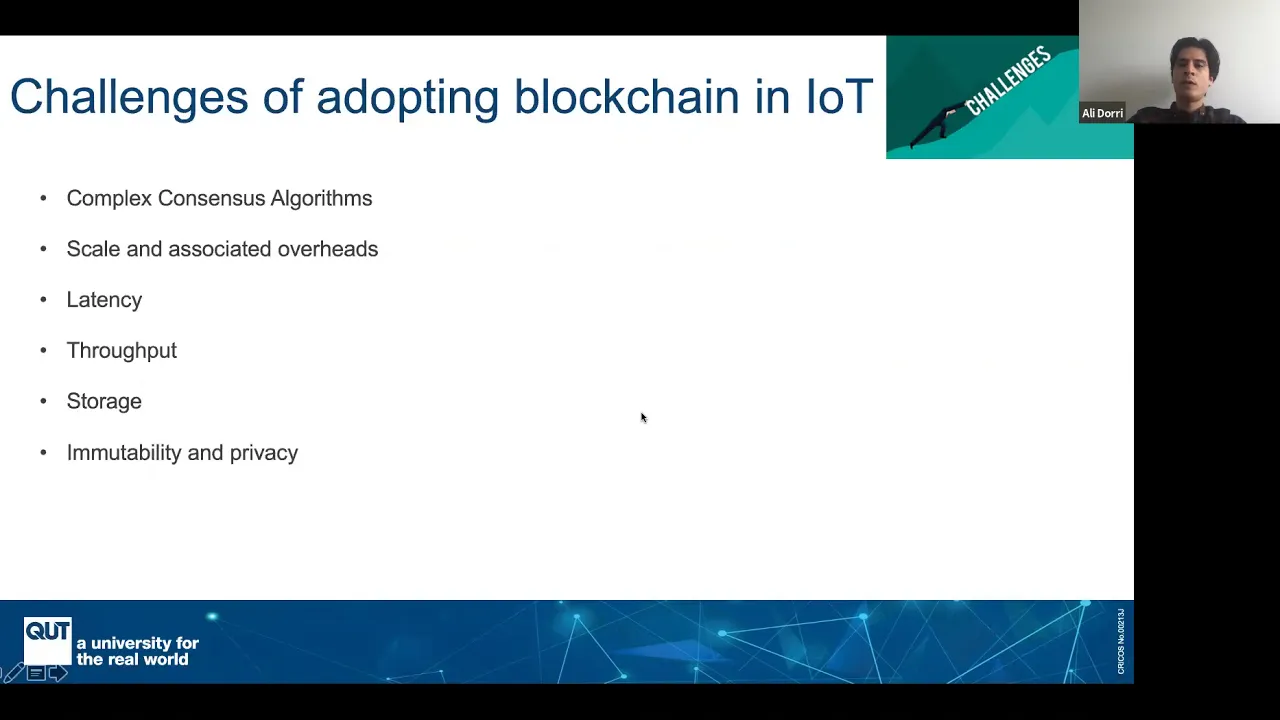
blockchains aren't sort of applicable for largest electrics again for some challenges here I'm listening some of those which I will talk about this in during this talk so the first is the complex consensus algorithms which is a quite an important thing particularly and with the proof-of-work as you can see and all your TV voice can never saw the proof-of-work puzzle I mean of course it depends on the difficulty but also the security would be impacted by that and also the concerns the IOT devices have very sort of limited resources and given that these devices has to sort of remain functional in a
area for quite a long time they need to spend their resources for their own tasks and also we have the scale and associated overheads non-problem everything is gonna be broadcasted everyone has to verify everything and then that's gonna create problems particularly if we see with millions of participants latency involves in storing a transaction and receiving the confirmation so assume that you're using a smart lock at your home and then you're using the blockchain based system when you click and open the door it takes ten seconds to open the door and that's not a proper thing with IOT because in IOT is like a real time
system and that the users need to receive services in almost real-time the existing block chains also suffer from limited throughput and the throughput is like the total number of transactions that can be a story in blockchain and that's limited I mean of course there are some improvements but considering locked and IOT with millions of users so still that would be limited through storage is there not another issue because I mean as you can see the source of the current Bitcoin blockchain I think it's about 250 70 gigabytes something but with IOT we can see that the size will exponentially and also would be hard to manage it and
the other thing is that the date and the IOT transactions might be linked to a data which is stored off the chain in another storage and if you want to make sure that the transaction is valid then you have to keep that data there is well to be able to prove that the data is there immutability and privacy so immutability is a good thing from one aspect the other side of it is that it creates some issues with the privacy so if your transactions are going to be there imploding forever and you can't control that then there would be a risk for privacy because there would be a lot of information historical information about you out there and then the
malicious nodes can try to classify these transactions and identify you based on those which I will explain later so I'll explain I'll start with explaining one of our research which is called like a scalable blockchain LSP for IOT the main aim is to reduce the overheads and particularly packet and computational overhead associated with blockchain in LSB you're saying that all the participating nodes including that IOT devices gateway service providers and cloud storage rooms and all the lay network so this overlay network is technically an overlay and four bits into the future benefit where they can communicate together to reduce the overheads like the packet overheads and
increase the scalability we're saying that the nodes are organized as clusters and only the cluster heads were responsible for managing the distributed ledger so here we are also using distributed down clustering algorithm so there's no centralization involved in business steps but then the nodes are creating the cluster so that say for instance the the more lightweight IOT devices would be the cluster members and there were more resource available devices can act as a cluster heads and manage the blockchain and all these things so in LS we are proposing a number of optimizations and to fit the oil tea context I mean these are into
disputed time-based consensus algorithm this was a trial version and a distributed throughput management algorithm which I will explain in details later so but before going to that let's talk about some of the fundamental concepts in Alice V in Alice we were separating the transaction flow from the data flow so that means that all the transactions are broadcast among the cluster heads but the data is actually being routed similar to the conventional networks from between two participants so I will explain and come back to this later so IOT devices might distort the data after change because it's not sort of scalable to store the data in blockchain
that obtain the storage can be cloud storage or local stores and also we are defining a concept of overlay block managers which technically are the same as the cluster head and they're responsible for managing the production so there are only the in theory only entities who are managing the blockchain and by generating verifying and storing the transactions on blocks and by conducting access control but what is access control so as you can see here here down is some very high-level overview block as LSP so this erased low resource available devices though are the IOT devices are connecting to the OBM or the cluster head and then the OBM
is technically the only parties who receives all the blockchain transactions so how can this device we can sort of connected or be communicated by other sort of participants in the class on the blockchain so this device can define an our authorize some particular public keys to send him transactions and that's defined and that's the one by using an access control list that is defined in OPM so each OPM maintains an access control list and that authorizes the other event and other overlay nodes to connect to these devices or connected across
terminals so the first optimization proposed in others V is the distributed time based consensus algorithm so based on this each OPM is permitted to generate one block per consensus period and that consensus period is a time for instance it can be 10 minutes similar to Bitcoin generation so that means during each during each consensus career each of the OB end is allowed to generate one block in order to make sure that there is no sort of collision between the blocks that have been generated by the OB ends
and they were not generating a block at the same time simultaneously so we're introducing a random waiting time so when whenever an OB m collects enough transactions it will generate random waiting time and wait for that time and then if it doesn't receive a new block that consisting that consists all those transactions then it will generate a new blue so we are enforcing these rules by in neighbor monitoring algorithms so the simple explanation is that if assume that this node is malicious it creates three blocks with the concerns armed with a sort of time period this is one minute and they wouldn't consensus weirdest animal so that means it technically is allowed
only to generate one block here these three minutes so when it sends these three blocks to the neighbors the neighbors will monitor that what when was the last block that this same OBM has generated and if ten minutes has been sort of passed since that time so because that that's not applicable in for these two say they would did reject these two blocks and then on the broadcast the first block which has been accepted and by the ledger so we also are proposing a distributed force algorithm but basically in conventional block chains so and when you're going to verify a new block you have to work for
all the transactions in the block and that's going to be computationally demanding particularly when we have significant number of blocks because of the like like high throughput of the network so then based on the distributed trust the portion of the transactions that are verified in new blocks is reduces as the old beams build up trust on each other so assume that I mean we are using to sort of evidences assume that OBM one is received a block from OB a mix so if obvious so opium war has direct evidence against X if opium war has previously verified some blocks
which have been generated by X and that's counted as a direct evidence an indirect evidence is all via Moy received and a block that has been verified prove it by a Z but not Y itself and then in that in this case we're saying that the boy has direct evidence indirect evidence against opium pigs so we are defining a trust table based on the direct and indirect evidence so the direct evidence has the highest weight so if there is direct evidence they would diss diss record the indirect ones but if there is no direct evidence they will consider than indirect evidence so if there's direct
evidence say for instance OB my has previously vary for ten blocks generated by OPM X and it was successful so now instead of verifying all the transactions in that block it will vary for 80% of randomly selected transactions to to make sure that actually those block is valid and if that 80% is valid it will consider the block as value so as you can see the lowest number is to any person I mean this shouldn't it should never be like zero or close to zero because and the OB ends might change the behavior and it's vulnerable against on an off attack where an OB MV acts honestly and when it gathers are sort of it's now trusted in
the network then it would start to act as malicious node and storing storing pick transactions I will come back to this when I discuss about the evaluations and attack securities the other optimization proposed by lsv is a distributed throughput management algorithm based on the DTM the network is measuring a utilization metric which is the total number of I mean here n is the number of nodes in each cluster R is the rate in which they are generating transactions T max is the transaction the total number of transactions that
are stored in each block in the blockchain and M is the number of all being ends in the master so here I mean as you can see the utilization is technically the number of transactions that are generated in the network divided by the number of transactions that can be stored in the book so we're saying that this always needs to be within a period of like alpha min and alpha max I mean this can be technically like 0 & 1 or any other values and assume that this value exceeds alpha max then that means the network is doing is generating more transactions than what the ob ins can store in the blockchain in that case the o beams have two options the first one and the first
thing that they were doing is that they tuned the consensus period they agree on a new consensus for you in a way that this again will match and will be valid and so this technically means that they're reducing the consensus period say that for instance in the past it was 10 seconds and in in each 10 second they're allowed to generate one block but now they're changing it to say 4 seconds and now in each five seconds they would be allowed to generate one block so that means technically doubling the true P but there is a minimum value of default for the consensus for you and that's based on the end-to-end delay in the network so we need to make sure that actually if we're generating the block
other participants or the opm's would be able to receive that before I generate the next look so that will prevent against collisions and four kings and all these things so in LSB we've defined the minimum consensus period as two and to end delay in the network and if that minimum value reached so the OPM's will start adding new audience to the network so that means them and the overlay network is not weak structure neo beams will join and then again they'll make sure that this father formula is imagining and they balance the throughput because the structuring or restructuring the OB and the overlay
Network is sort of requires more resources in terms of packet overhead and processing time so the first thing that they do is to agree on reducing the consensus period and then they'll change the OB any numbers so this algorithm not only allows to manage the load when we have more - more load in the network than the throughput but also the hips to save the resources of the OB ends if we if the network load now is less than what is expected or what the blockchain can restore which I was showing the simulation results so a simple example of how the transactions are handled in
LSB so assume that this requester is gonna request the information about this smoke sensor it was creating multidistrict transactions in this transaction requires both the requester and the temp so to sign this transaction to be considered as bali and it will send it to its local OBM the allbeing will receive the transaction will check the access control list to see if the receiver public key is in the access control list otherwise it will broadcast it with all the other OB ins and then the one that finds a match will send the transaction to this monster then this watch am so basically we'll follow the
transaction let's send the requested data as you see in the data has been directly sent today request there and then it will sign the transaction and broadcast in the blockchain the technical is sending it to the local OB m and then the OB ends will broadcast the conversion here also may need to shame that by direct communication we don't mean that to using the IP communications or something like that it's basically meaning that it will send it to the local OPM and then the OPM's apply and rotting algorithm and then this OPM would send the will route the packet to this OPM and then this all being will send it to the requester this
is what we mean by direct communication or directly sending the packets so some of the results for LSB so as you can see here we are comparing the processing time for verifying new blocks so these are the number of blocks been generated in the network and as you can see this is the percentage of transactions to be verified based on that trust table as more blocks are generated the percent of percentage of transactions to be verified is reduced because they are building trust on each other as you can see as the this reduces the difference between LSB and the baseline which verifies all the transactions increases so that means we are saving the
processing time but at the same time we're also introducing a risk that for instance a transaction a fake transaction might not be captured by the OPM's because say for instance they are verifying all the 20% 40% of the transactions and what if transaction a fake transaction is included in the rest of the block so we have evaluated that as well so we are considering a highly trusted node based on our own to our stable which is saying that 80% of the transactions will be considered valid and just 20% of the transaction needs to be validated as I said this 20% is selected randomly it's not always selecting the first twenty percent so we
can see that at least we need thirteen honest OPM's with forward a trust able to be able to detect that attacked attacked so if only one of the OB ins detect that fake transaction it will inform the rest of the network and that transaction and that block is going to do and removed from the blockchain and so it's like that OPM trust value for that OPM de Putte impacted by the malicious behavior the other thing that this diagram showing is basically the packet overhead because we are clustered the network so evidently the packet overhead will reduce here is the impact of the throughput so initially the consensus period was ten seconds but
then when we increased the number of transactions so the OPM's wooden handle those transactions so they reduced their value of the consensus for you and then you can see that later on the transaction number increase but the seat that can handle that but then when the number of transactions again reduced shortly so they increase the consensus period so that they are not wasting resources on creating too much plots and they just generate blocks if it's neither okay so these are basically the discussions around lsv our lightweight scalable blockchain so next I will move to the discussion around immutability
and the challenges associated with the image ability of the blockchain so the good thing is that the blockchain immutability ensures security because it's a temporal resistance network it ensures auditability or transparency of the blockchain because all the transactions would be there permanently so everyone can track can record and also it protects somehow against double spending attack where when you can verify that previous treatment such as nothing spent twice what the other side is that because of the immutability of the blockchain the size of the blockchain database is increasing I mean this is the size of the Bitcoin
blockchain but if you consider IOT then you have millions of nodes and technically you will have much more to put than the Bitcoin so you can imagine what would be the number of blockchain sites the other thing is that the persistence of the transactions in order to in the blockchain database will privacy concerns so as we know in Bitcoin this is on quite well studied that the attackers can classify the transactions evaluate for instance what transactions been used at the input what is the output and what was the public is involved and then create graphs and then classify the transactions and probably
linking them to users maybe even using off chain information the same applies in all UT as well in a separate research which is not part of this presentation we've studied the anonymity in an IOT setting we've studied the anonymity for the smart home users so then we've found out that the attacker is able to classify with 90% accuracy there are the type of devices that you have installed in your home and that's by classifying by deploying machine learning algorithms on top of the blockchain database because everything is public everything is there forever and then the thing is that as you add more devices to your oil T Network the attacker technically has
more historical information about you so if you can find out one of your public kids then technically they can link their transactions together and found out more information about you which is called the like the DN analyzation attack or linking attack in literature and that's the problem with the persistence of the data in blockchain and this is also linked back to the GDP or and regulations like the user demand the right to be forgotten so the information need to be been required to be able to remove the information from the blockchain what a block to conventional blockchain doesn't allow that and what if someone stores illegal
information in the blockchain how you can sort of treat that how we can remove those information from the block the other specific challenge for IOT is that the oil T devices or participants normally demand flexible transaction more what I mean by flexible is that they're they don't need to store the transaction permanently in somewhere in that database because for instance if I'm signing a contract with the service provider for one year I probably need this transaction that bill communications only for one year and not no longer than that right and so I why does the information needs to be in the blockchain go and read the attacker so
that they can G anonymize me the IOT devices require doggers sort of storage requirements they require to store it from transaction for a particular period of time they require to be able to summarize their transactions so by summarization means consolidating transactions into one transaction so if the transaction is linked to and to data stored in somewhere then the user might decide to compress that data to state space but that's not possible in looking and because if if you do that then that technically the hash will change and would it match with the hash that is a store in the blockchain and of course in some application we do need the
permanent storage of the transactions so we have come up with distribution where you can protect the right to be forgotten and also address the challenges that aren't mentioned and we call this solution memory optimized and flexible blockchain most PC so most PC is a sort of removable lodging which allows you to remove your information from the clock chain and thus experience exists all the right to be forgotten and I'm given that it allows you to remove information it helps to reduce the blockchain storage requirements and the cost in managing the water and also even if you remove your transaction from the
blockchain there is still is a level of auditability that are me you can store your transactions locally and use the blockchain I mean if later you need it then you can just reveal the transaction same but okay this was the previous list for transaction in the blockchain and the network can trust on that but it is still there it introduces that level of auditability well and enabling the users to remove the transactions here is an very high-level review of Mothe BC so we have the p2p Network we have the blockchain layer network so we are we're not considering what sort of consensus algorithm you're using and all these things because technically that wouldn't impact most BC
functionality so here is the most BC layer where we are defining multiple agents that can help and facilitate the removal removing of transactions from the blockchain I'll come back to this later and I'll explain some of these agents may be the first concept and the most important one is that how we remove transactions from blockchain but still make sure that the blockchain is consistent so as you can see in conventional block chains the block ID is calculated by hashing the transaction contents and the block header so if you remove a transaction technically this hash cannot be recalculated and then that will break
the consistency of the network but in most PC the way that we are calculating the hash ID and the block ID is that buren correct and calculating the hash by hashing the transaction IDs instead of the transaction content so this transaction ID is something that is already there in all the transactions and it's technically is the hash of all the transaction content so that means is still the integrity of the transaction is maintained but if you want to for instance in this case if you want to remove the transit transaction to you will remove the transit transaction content but you'll maintain the hash of the transaction and in this way the this final block ID they can still
recalculate that and this hash that is still maintained in the blockchain will introduce a level of audit ability for you you can store this contents often in your local storage and whenever you need to prove that this transaction was part of the blockchain we will just reveal the transaction content and then if the hash of that content matches with this hash then everyone can trust that technically you are on the order of a transaction which has been previously stolen the blockchain but now it's been removed so this is the very I mean sort of basic concept that we are enabling the users to remove information from the blockchain by changing how we are calculating the block hash ID I know
that for instance in aetherium there is also an estate ID or something that also involves other steps to be taken and to make sure that the state of the ledger is valid as well so here we are introducing different transaction modes as I said that the user might demand a temporary transaction so we are enabling the users to store transaction for a specific period of time so this can be done by defining expiry time or whenever I see that I don't need this transaction anymore I'll just remove that transaction because the network to remove it from me we're also enabling the users to summarize their transactions so by
summarization we mean that actually assume that for instance I'm the owner of these four transactions I can summarize this for transactions in one transaction so all the inputs which are not spent in these sort of all the inputs which are coming from outside to these transactions are used as the inputs of this transaction in summarise transactions and all the outputs which are not spent for instance output for five or here included as the output of these transactions and here you can see but for instance this output has been already spent in this transaction and so we don't need to consider that output in these transactions so again this is also we are using the Merkel adriennes
concept also to enable the user to prove the existence of each single transaction in this summarized transaction so if you're even you're removing all the transactions summarizing it to one transaction you will still be able to prove that each of these transactions been part of the summarized transaction we're enabling the users to age their data or compress their data once you're compressing the data so that turns the initial transit would be redirected to another transaction and then we're proposing a blackboard which is a read on the database and that that blackboard is I sort of maintaining the idea of the
redirected transactions and all and of course that we have the permanent storage of transaction which is similar to other than book chains but the problem is that I mean as I said with the IOT we'll have significantly large database with the blockchain so how can we incentivize the users or the full nodes basically to store that allocate the space just for storing that so we are introducing storage fee which is an additional fee to the transaction fee and that storage fee is based on the transaction size so depending on what size of is your transaction you are
being charged by an storage fee and each obn during each bounce are each minor or validate or basically during each period of specific periods of time they will receive all the collected trans storage fees based on the amount of storage and the period of time and that they've sort of dedicated storage for storing the blockchain so the blockchain database might be a hundred gigabytes you might on the dedicate 20 gigabytes for storing better then us block chains or the newest chains but then you will be paid based on that it also motivates the user to remove their transactions so
technically the concept is here is that if you want to sort of increase the blockchain size you have to pay and also if for instance you have transaction and and previously have a store the transaction you've paid the storage size a storage fee and now you want to store another one so if you remove the previous transaction and then store the new one so technically you haven't changed the blockchain size so there's no change in that one transaction is been removed and a new one is being stored so technically you don't need to pay so then it also removes sort of motivates the users to remove their transactions from the blockchain and
help reducing the size of the blockchain this removal of the transactions and all these incurs a bit of processing overhead because the validators the nodes has to vary to find and locate all the export transactions all the transactions that are going to be summarized and all these things so then we are defining a cleaning period that at the end of these periods all the validators will go back and remove all the export transactions instead of continuously doing down in most BC we are enabling the user a service provider or the network to remove transactions so
the user and service provider will somehow I mean technically they are the same but in some times the service providers in all UT applications might demand to have control over the user transaction to be able to remove their transaction for instance if they store freaking formation or false information the blockchain but the network one is when a user wants to offload the processing overhead for storing or removing transactions to the blockchain network and ask the network to all do all the removal and stuff like that so assume that I have a temporary transaction in the blockchain or I will store the transaction in the blockchain and now I've decided that I do not I
don't need that transaction anymore so what I can do is that I can send it create another transaction and request the network that ok hey this is this was my previous transaction I don't need that transaction anymore I know I want to remove that but the first thing is that the network has to make sure that actually I'm the owner of that previous transaction that I'm going to very to remove so I'm for that technically I need to reveal the join the new transaction with the private key associated with the public key of the previous transaction so in all your tea given that each transaction is generated by a separate key to ensure anonymity and then given that there are
millions of devices and each user will have tens of devices and this device is frequently generate transactions so this will lead to a key problem key management problem how can we store all these and public key private keys in the segment so what we are doing is that we are introducing the concept of a generator verifier which allows the users to prove ownership of a particular transaction by only knowing or storing one public key and one secret value I mean this secret value can be like similar to can be like a password it can be your fingerprints anything so the way that it works is that you store a
generator very for this value in the transactions when you are creating that transaction later if you want to prove that your the honor of that transaction you have to reveal I mean this GV is been built for encrypting two values which one is the previous transaction ID of the same transaction and the other one is that generator very far secret and that's the secret only notes by you you can change this secret for each transaction by applying simple pattern for instance adding announced value to it to make sure another level of security is there but then when you want to prove the ownership of a transaction you will technically reveal these two values and then sign the transaction
with the private key associated with this public so if you can do that then technically that means you're the owner of that transaction and now you can do anything you want with that transaction if you want to remove it if you want to summarize it if you want to do the aging or anything when it goes to the network initiated memory optimization the when a user is generating a transaction initially it will identify what sort of optimization has to be done and when for instance I would say I want this transaction to be removed in one year so that means technically the transaction has an expiry time of one year right so and then if you remember from the previous slides here all these age
dare to associate the removal of such transactions for instance this agent as a summary manager agents so it will collect your transactions that are can be summarized and during each epic time or based on your definition it will create a summary transaction and broadcast it to the network and then the miners will verify that and then sort of remove this transaction from the blockchain and the same applies for others right so I'm not going to go to the details of all these agents but technically they are doing what are you supposed to do if in during the user initiated memory optimization when you
are using Network initiated memory optimization so in this way you can make sure that actually the network is handling and it's removing your transactions based on the rules that you have defined in a particular period of time so again security is achieved here so you don't need the this GB here because technically you have generated the transaction you have signed that transaction so you have decided that this transaction will be removed or it would be compressed or whatever optimization that you want to apply on that and sort of you don't need to prove again because you wouldn't touch on this again so a bit of evaluations so here you can see that we have the permanent
storage of the blockchain we have the temporary chain and we also have the summarized Apollo one so as you can see the size of the blockchain reduces evidently as we reduce the number of transactions and you can see that the cost that the user also is paying for the transaction so this is the technically damn storage cost is also reduced but you can see a significant reduction in the summarized about one and the reason is that for instance here you've stood initially ten transactions and now you've decided to compress all those ten transactions into one transaction so technically you've paid ten transaction fee or ten
ten times transaction fee and now you can store knowing more transactions without paying anything because the consolidated all those transactions into one transaction but then this this is not the case where the temporary one because with the temporary one you'll need to generate another transaction to remove a previous transaction I mean of course the soy is different but it still you will need to have some sort of transactions I mean this is the good side of it the other side of it is the processing overhead which move PC will incur as I said all the validators have to go through the blockchain flowing all these transactions that they have to
verify on they have to again verify that for instance you are the honor of this transaction if the summarization is correct and all these things so this will in cure processing overhead and here we've evaluated that processing overhead and they see that so of course in permanent one we don't have any overhead because you don't remove anything but in the temporary and summarize about money we have some overheads because you need to remove previous information in the blockchain you have to locate them and you have to do all the verifications so we have changed these two to dollar based on the cost that they are incurring and we are saying that the still the benefits offered by blockchain
are more PC and it's significant in terms of the cost that it that it will incur in terms of the processing overhead and that's it thanks for your attention here is our group website at QUT so we are working on different projects including the scalable blockchain for internal things as in this project we're working on similar concept that I've just explained and working in lightweight frameworks other frameworks we're working also especially for blockchain 4 and this we did energy management we and with our other collaborators from UNSW and University of Sydney in Monash University and also
we're working on anonymity of the blockchain as I said what this one is particularly for IOT where we are how the users can BD anonymized on blockchain based IOT system so thanks for your attention and if you have any question just um you can ask here or maybe email me and your information about the future talks that we're looking forward to you thanks everybody thank you Thank You Ali that was really good so do we have any questions um Isis why Griffin here what video on to
me I sort of um that we we do some work with IIT as well but down swanee Inuit research if you've done anything around what sort of benefits tickets I'm actually being able to chain the blocks together like I mean obviously with a financial system you have a dependency of you know if you gave me ten dollars I can't spend twenty but I'm talking about what actual training any aspects of that that might be if I'm understanding quickly it's like what are the benefits of having the blockchain right so I think one of the I agree with the fact
that the blockchain in all it is different with the blockchain in in crypto currencies as we said in crypto currency we need the complex consensus diversion to make sure and to prevent the double spending attack but technically in all you see that's not normally applicable unless there is some assets to be transferred and in most of our IT applications we just want to store the communications validate that and all these things and that's why we are saying that we can relax those assumptions with new lightweight consensus algorithm that would be more applicable with more throughput with I mean for instance LSB is sort of a self scaling Network right so whatever through putting to how what extent
in greases it can manage that so and that's why we're saying that we actually don't need that much overhead that's a really good point because in IOT we don't need that much overhead we don't need to protect against or consider those sort of attacks so we can simply simplify the algorithms of the blockchain in a way to make it adoptable and based on only the oil T concepts Thanks you know you had the I can't remember your turn but where you could compress say ten transactions into one
concept so if those transactions relate to say some I'm know IOT camera that taking photos surely it's got each transaction has got some real information in it that you need to keep so how does company am I wrong or how does compressing work there yeah definitely I mean you're right so definitely that transaction has some value that the initial F generated that the point is that for instance maybe after six months I don't need to have all these information available in
watching so what I can do is that I can store all this information locally for instance and then all these transactions and then summarize them in the blockchain in one transaction and it still I would be able to for instance say that this is like the camera information I would still be able to prove that this one was part of the blockchain that now has been removed and then but I can remove it from the blockchain and keep it locally because of to make sure that the blockchain sauce is not there it's not increasing or the privacy my own privacy so I wanted these to be consolidated in these transactions so that the attacker wouldn't classify those transactions and also want to as you said keep a level of
audit ability but this normally will apply when for instance period of time has passed that you'll probably see that now I don't need to restore the fool transaction in the blockchain probably on referring to that transaction less frequently than the new transactions okay make sense are there any other questions all right well thank you very much for your talk today and yeah thank you thanks everyone thanks a lot thank you thank you right
yeah bye-bye [Music]