Supply Chain on Blockchain Overview - Pre-Conference Webinar
Ethereum Engineering Group Talks · 2019 · 41:19
Dr Valéri Natanelov, a postdoctoral research fellow in Queensland, gives a gentle introduction to supply chains and blockchain ahead of the Supply Chain on Blockchain Conference in Brisbane. The webinar starts from the basics of trade and institutions, explains blockchain as a shared ledger with smart contracts, and shows how linking physical goods such as property, diamonds and beef to digital assets can lower monitoring and transaction costs. A beef traceability project illustrates sensors, IoT data and smart contracts in practice.
Speakers
Topics
From Ethereum Engineering Group Talks; community: Ethereum Engineering Group.
Transcript
okay hello and welcome everyone this is the webinar for the supply chain on blockchain conference to give you a bit of an introduction to the area so Val please take it away thank you Peter hi everybody my name is Val or for more formal setting dr. Valeri net in Elif I am a postdoc research fellow at the University of Queensland University of Technology working on the B Fletcher project so today we'll be discussing in a very simple and gentle manner the concept of supply chain and blockchain and how they come together this meant as an introduction to both elucidate the concepts to you and hopefully entice you
to either attend or watch and read more on the supply chain of watching Conference of the 15th of July so we'll keep this quite in the formal so the participants can ask questions during the presentation or after and hopefully everybody will have a good time so let's hit it off now before we start talking about very hype and sexy concepts of blockchain I would like to focus on the basic socio-economic concepts and let's look at sort of the historical concept of trade right like it existed from the times of Silk Road and before we had merchants sending away goods to distant places and there was always trade existing and what was important in that
situation is that we always want to minimize uncertainty and increase the efficiency of trades where we can exchange value now traditionally this was done through sending your family members with a caravan and even armed forces to join them however over time this went into a more formal setting and these sort of settings where we conduct trade in our coin by Douglas in north as institutions I know most of you have an idea that institutions are these sort of semi governmental agencies but the concept of institutions is quite simply the humanly-devised rules and constraints and structures to facilitate
this more fishing trade now the role of this Ecsta tution specifically is all about agency and contract enforcement again I mentioned you know in the olden days this was about sending a family member and armed forces with you more modern sense this meant like it's settings like banks letter of credits and other administrative tools and another role of institutions is that for efficient markets what we want is low monitoring and transaction costs this will become a bit more clear when we come back to the concept of supply chains but here keep in mind that when two parties engage in
trade often problems arise when there is an asymmetry in the transaction cost okay now let's focus on the concept of supply chain itself I just described very very briefly the concept of trade between let's say two parties and the supply chain simply is a system or a network of resources organizations individuals activities technologies information and any type of goods services processes to throw out a chain to add value and deliver a final good or product or service to an end consumer now here what is important to note is that there is a flow of goods throughout
the chain between different entities and there is a flow of money throughout this flow there is also other actors such as logistics companies and and transport but also banks for financing and insurances for you know protecting risk and minimizing that uncertainty now this supply chain that is represented here very nicely often in practice it's more complicated where you have some entities taking care of several steps or only one other times this can be fully integrated and that's what we call a vertical integration now an interesting question might be why don't we have a few hundred companies in the world who are fully integrated and take care of our goods
and needs and resources well the simple answer to that is not to go into much detail is that in a vertical integrated system that system is very unruly and so when things change and all of us know that things change all the time the system or that company cannot adapt and that's why that large companies often have more potential for higher efficiency and also higher margins but there is also higher risk when something goes wrong their whole supply chain will crumble and you know they'll have to encounter a lot of losses so in a way supply chains are very organically form throughout the let's say formation of economies and civilizations and they're very necessary
and often these supply chains are not necessarily formalized it's basically actors that are interacting with each other and they're doing the best to do this as efficient as possible in other cases this can be more formalized through a formalized network organizations associations that try to help networks and different actors to make the process more efficient and interact and transact smoothly and more efficiently so what's important to keep in mind here so in each of these transactions steps between different entities the goal is always the same we want to minimize uncertainty and we want to make the trade and exchange of value
more efficient and again how do we do that we always do that focusing on agency and contract enforcement and on other end we want low monitoring and transaction cost now in terms of the supply chain they don't exist for the sake of themselves there is always the end goal which is the demand from the end consumer right for example when a consumer or viewer looks at this jacket they see a jacket a supply chain manager would not see a jacket he would see a whole system of activities and transactions that go from the growing of cotton crop and everything that goes with it to processing it selling it abroad moving into logistics taking care of the
buttons and other let's say components of this holistic product let's call that the at the end is delivered and distributed to the end consumer okay so here I would like to sort of again highlight that the supply chain can be very complicated but in its core it's all about transaction sort of the cascading transactions of goods and services between entities and here we want to focus again on minimizing the uncertainty and making sure that when the goods are sent there is a flow of money in return within the agreed set of terms now when I mentioned the whole Silk Road and the traditional
setting let's say the old school setting I always think of Marco Polo offer what are those so the problem what's important they don't hear that whenever we want to talk about monitoring and transaction cost and making sure that that contracts are forced what is important is standardization about agreements of what is quality what metrics do we use and what quality of a specific product that needs to be predefined is agreed for a predefined price and this is something that's often you know in practice requires either bartering between parties or create some kind of friction within the supply chain system okay I hope this was somewhat clear I'll come back to this after we
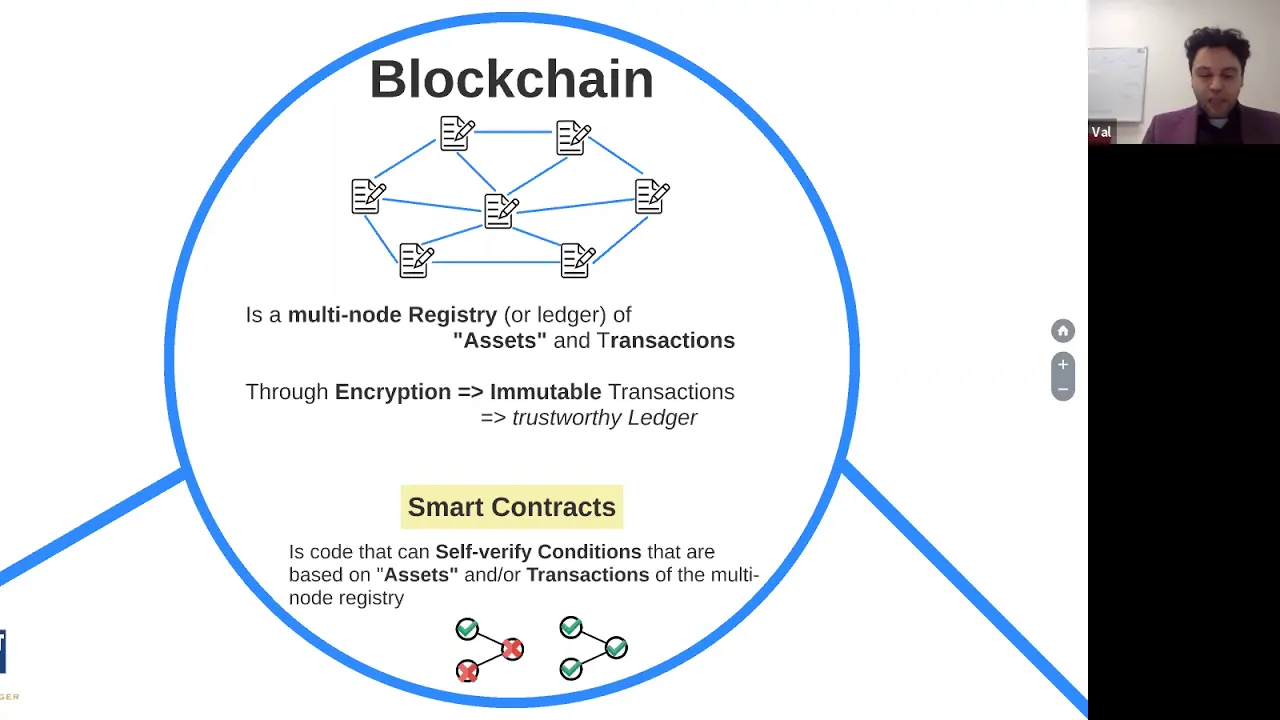
look at the concept of blockchain now I'm sure all of you heard about blockchain and I'll try to impervious ly avoid words that are already sort of predetermined and linked to it and I always like to explain blockchain as a multi node registry so an registry is basically taking notes right so we have different nodes wherever an asset and the transactions are noted on and whenever a new transaction occurs these are noted on the whole system so everybody has the same copy and through encryption this becomes immutable and
trustworthy so in a nutshell a blockchain is a multi node registry or a ledger that contains assets and why I quoted the term asset it's because you know we're talking here about digital assets and the transaction so the easiest example of this is Bitcoin the assets itself is a digital concert people give value to and people transact that between each other and each time there is a transaction each note has a note of that so because of this it makes it quite efficient and immutable makes it very trustworthy now an additional layer that is of interest
is the concept of smart contracts now when we have a transaction of different assets that are immutable we can also build certain conditions built built on top of these transactions that can be either executed or not if these conditions are met again I'll come back to this in a bit but before moving on we'll come back to this concept of a digital asset so what goes it good is a blockchain to you or me yes it's fantastic for having transacting digital currencies but most people are not very convinced by that and the real let's say magical value of blockchain consists
where we can link that digital technology to real-world assets and the most easy example is often with real estate so for example in Europe the notaries I guess in Australia and other ones this would be the solicitors embark on the blockchain journey because they see that in their case because their job is mostly record assets which is let's say houses and a different type of you know buildings and note how they are transacted who is a different owner so that's basically like the simplest definition of a real world application on the blockchain where a house has an owner so the house is asset and sometimes the owner change and there
is a transaction currently we do that through again notaries or solicitors and through the blockchain this could be a much more efficient system and a smooth system to come to the same and result now why do I mention housing because that's an easy example because with a house you can write the house address and digitize that and make that into a digital asset ok so when we have a house you cannot really move the house and change the house so it's also impossible to cheat from the physical sphere and relatively easy to translate that concept of a real-world asset into a digital asset and continue into its transactions things become a little bit
more tricky when we start talking about different assets for example there is interesting blockchain and diamonds where you know diamonds are high-value assets that can be transacted between different parties now in case of diamonds you'll have to come to packaging and different ways to make sure that to protect that the link between your physical asset and the digital asset or the the translation identification of that asset it's not only accurate but also secure and immutable in itself because the blockchain ensures the immutability within the digital realm however it
requires you know an additional design step or thinking step when considering the physical assets ok I know I devote a little bit extra time that but it is very important when we talk about supply chains and when we talk about the supply chain and the blockchain as I just mentioned we can see almost intuitively that is an organic evolution of going using the blockchain technology to make the supply chain markets more efficient I mentioned for a good supply chain and the general trading situation we want low monitoring cost and agency and contract enforcement so what does not offer us it offer us an immutable ledger of assets and transactions which is
beautiful that's what we want we want low monitoring and transaction cost and it also offered us concept of agency and contracts informants through smart contracts ok now that's very nice and it means that there is sort of a push from the supply side to adopt technology or at least explore it further however there is also maybe even more important the sink or the demand-pull site from the evolving consumer now the consumer is in the end the one that holds the power of spending their hard-earned money right and the consumer today is always changing and evolving especially in the time of
social media where they're not only wanting to their concerns about product safety be verified but they also want to know if a certain quality and I tell adji is met when producing transacting developing or any type of process within the supply chain of their end product of service that they can see you and hear again in terms of product safety quality and ideology we come back that blockchain can offer another efficiency tool to provide that service or let's say that additional value to the consumer where we can have more product information that is both focused on safety and quality but also an
ideologist residents humor and can facilitate their decision in the buying process right and of course the consumer is not only once the the the ideas of of digital information they want it to be both trustworthy and immutable I'm not sure how many people still trust the word green or the label organic they also wanted to be presented in to them in a more accessible way now it is also here that blockchain offers very interesting opportunities where the end consumer can inherently by design trust the system that the information presented there about food safety is
accurate but also in talent there's information that sells them where is a certain product made you know I mentioned this jacket and when I spend my money let's say I would like it to make sure that the process of making this jacket doesn't include environmentally damaging processes or certain label standards that are met or in a country that I like or prefer or accede as a high quality standard and for this reason as well blockchain can in the same concept of an immutable ledger that presents as its transaction information to the end-user present an optimal situation to utilize that in the supply
chain now to summarize we mentioned the basic concept of trade how supply chain in a simple way is a chain of different transactions between different entities we want to minimize uncertainty and maximize the efficiency and that blockchain could be event a very interesting tool and a technology to do so I also mentioned that there are some bottlenecks or some things that need to be overcome before this technology really becomes feasible in the real world market when we have that concept of physical assets and digital assets and on the other end we also have business as usual because in a perfect world this presentation make it seem
that oh well let's the top blockchain as it is however there is a transitional stage where the current supply chains are operating quite okay like everything is relative so when we talk about efficiency we mean that things can be better but things still working I can still buy a jacket and a shirt and the sandwich and this transaction still happened today in different manners so for example some things are still on pen and paper other things are relatively digitized if we look at concepts like the digital platforms on Alibaba or different other ways to exchange goods however in terms of the transitioning from a current state of a supply chain
to let's say a more efficient and effective way of using supply chain these two concepts need to be overcome and why do I highlight it specifically because now we're going to look into a specific example the the be Fletcher project where we see that you know in the initial stages where we have contact with different market participants and you also see that unlike the conceptual presentation the real-world situation is already much more complicated and still this is a very symbolic representation and the real supply drinking is even more complicated where we have different actors potentially interacting with different
with each other or in a different way and also creating different possibilities of exchanging that value now here the main question is always about how do you link physical assets to digital assets and in a way other technology paves the way for that so we have the concept of IOT or Internet of Things basically these are technological devices that are added linked or engage with with the physical process that either can store data about the process so for example in our case we will be looking at the geolocation of cattle but
also on their general well-being standards from oxygenation level and temperature level to ensure that we know not only which animal is linked to what ID digital ID but also to give properly information about let's say the aggregate value that we want to offer to the entrance humor where that traceability not can start from the beginning but also the following and aggregating of information has to happen there now that's a fantastic thing however in order to apply that to a hope supply chain it requires the
collaboration and use of all the supply chain participants so in order to say that the stake that will be exported and finally eaten by somebody in Asia or Shanghai let's say that we know from which breeding property comes the the process that went through about reporting about its animal welfare where it was slaughtered etc and that the product during shipping and other transport maintained high quality standards of temperature to ensure that this nice piece of steak that the end consumer is eating is also
communicated at consumer and they can be fully engaged with the product and have food trust in that now that also implies that we will have a huge amount of data and it's not always very sexy data let's sail you know where the weight of the cattle the temperature of the cattle and how the cattle is moved and processed but also the data of the transaction ability at current state where we have a buyer report or certain help declarations these only to be sort of absorbed into next layer and harmonized and standardized you couldn't say 'no way and be fed into the let's say the
blockchain layer in that blockchain layer we can have the ability to transact let's say the the transaction so it will be immutable but also create smart contracts based on certain variables so let's say i'm pieter have a deal where i promised him to deliver a certain amount of cattle of a certain breed of a certain quality and we agree on a specific price the cattle is delivered and peter claims that well well that cattle he promised it's all great but its marbling score and the feather if happening level of the beef is not as high as he promised so i'm not interested to pay as we agree
and to make sure that these kind of discussions don't cause tension or friction in the chain through that data processing and and digitization basically the immutable component of it i can say oh you know what peter let's have a look at the data you might be right but you're exaggerating a bit I'm okay to take a cut of two percent and through that process made the transaction more smooth now I also mentioned this example for another reason because when we talk about blockchain supply chain and smart contracts often people think like wonderful we don't need people let's just have robots they will transact everything and you know this this
process will be fully automated well yes and no in a way we will we are far from if we ever reach there from that full automation and we must never forget that the concept of trade can never ignore the human aspect ok so yes we can create smart contract that pre-programmed certain execution in functional trade but in case of beef ledger for example what we always want to make sure that we focus on the information transparency and keep in mind that the information asymmetry was the main problem of high transaction costs and created issues in in trader and and between you know
parties and in the supply chain so that the entities themselves can decide to proceed and within a certain range of negotiation ok and it is here that the concept and the and the practice are brought together and while interesting it is quite a lot of work but the potential is quite high because both from the supplier side let's say the supply chain itself a lot of deficiency can't be gained and at the same time the evolving consumer creates a lot of incentives and in time will demand more accurate information about the product ooh now that was a bit of a whirlwind I hope it's you know reached
the audience to some extent and please feel free now to give me all kinds of complicated and difficult questions or simple ones and thank you for listening Peter I think now we can move to the question section yes for sure I'm thinking I'm thinking up my own question right as we speak I know my initial question is actually as a warm up for everyone else is not actually directly related but related to your example so do so people who were growing cattle for
sale they the cow doesn't live on the same property from when it's born to when it you know goes off for slaughter if there are completely separate places for the feedlot and fattening property so that is that is that how so it could all in different way so some breeders can also grow their own cattle and sell it on the sale yard or to the abattoir other breeders or the same breeder can sell some of its cattle as relatively young to feedlot and often a feedlot is a grain fed but sometimes it can also be granted but let's say that the feedlot
is where our cattle is grain fed to reach maturity and then can be again either sold to sale yard or directly to an abattoir or that let's call them that if the feedlot producer can choose to say I'm gonna pay the abattoir to process my cattle and I'm gonna export myself and same goes for the fattening property of a grass that one where somebody says no grass fed cattle is more tasty that is my brand that's what I like that's what I believe in that's my family did they can engage in a similar process and why I complicate this a bit because a supply chain is never as simple as little dots connecting to each other each entity can
choose to engage in one specialized service or can say well I see more potential and I think I have the capability to transact several steps of the supply chain and in doing so increasing my margins or profit but also providing more value or having to do extra work I don't know if that answers your question somewhat but III think that the the important thing is that the breeding property can be specialized but can also choose to conduct other parts of or other steps of the supply chain and that's why in practice often these supply chains are entangled and most
people do several things where a part of cattle for example from a feedlot is sold directly to a sale yard and maybe a smaller part is sold sort of is exported by themselves where they buy services from abattoir and logistics companies to try to export them and and the question here is always about like diversification and making sure that there is enough ability to handle different steps of the supply chain because keep in mind when I mentioned you could say well and they exist there are huge companies that go through the whole process by themselves okay and you can start specializing in one step or
several steps but the bigger you get the more difficult it is to remain resilient throughout the process and what do I mean by that for example let's say if you're a big company and there is a drought or a disease the the whole collapse or the blow will have to be taken on the much larger scale while the supply cheese could adapt more quickly and still interacting in value creation and value addition see you Mack do you have a question yes actually I have two questions basically my questions is related to the mechanism that large involves you know let's say I'm your restaurant and I want
to order steak does it mean that I need many other people to confirm the quality of the steak based on their actually version of the information that that they have there are under machines and the second question is these block chain or I chain based on life change does it mean that the organ is that we don't need anymore we don't need organizations that monitor the quality of let's say product let's say they provide a label on the product that indicates the
quality of the product are I mean is this supply chain on blockchain replaces those organizations okay a very interesting question so let's let's do them one by one we you talked about a customer when they want to confirm certain quality of a state in the restaurant correct and you said like traditionally what you would have is that a customer is in the restaurant and there is a yelp review and then people if sort of socialize comments about the restaurant itself and about some dishes that's the situation right now and you ask in a way what's different or similar if we would use that system where the
customer can verify the quality through the blockchain well the the difference is quite pronounced on or you know quite elegant as well because right now I know things about the restaurant I am from a social perspective I know that maybe there has been and this is a way related to your second question a certification from a health inspector on the restaurant with a letter P or a or whatever and I also know that people like it but I never know that the piece of beef or whatever is on my meal what is exactly up with that what is that piece is quality specifically and what was its journey etc so the advantage of
using a blockchain based system is that the customer can still rely on the the general let's say evaluation of his peers and the health rating of the inspector and other ratings but the specification of what you're consuming right now is not there and matter of time that the customers say that I want to know what this piece of meat what is its quality why is it cost so much and what am I paying for and that's the advantage of having the let's say the blockchain system or one of and of course why I presented that that layered system of beef let you because the one
doesn't have to exclude the other in a way you create more information because a restaurant can still function as it is and let's assume that restaurant is part of the beef ledger system that rester can say oh and if you you know scan a QR code here or there or next to your plate if they want to be that advanced you can add even more information and more sort of clarification transparency about what you're consuming right now the story about that so that should cover the first question and in a way your second question is somewhat related where you ask well what about the the you know these organizations that currently exist and need to ensure the health rating or the quality they don't necessarily need to
go but their life and the work can be made much easier because the whole process that we are describing right now involves different actors but also involves policymakers customs it involves verification of points of origin and health and quality as well so all these actors they're quite important in our supply chains and the products we consume they try to do their best to make sure that not only they're safe but they're actually represented in quality but that the globe thing can make things much easier because if that actor is still there and they should be there we were not propagating to say oh these
actors are not important anymore but they can really have a much smoother and efficient way of providing that quality assessment because normally you have random sampling and you give someone a quality system but here you can always have a continuous stream to make sure that certain flow of products retains a certain level of quality and and and the goal here is not one revolution where we say oh let's throw away all these things enough it is more one of evolution when we say we can focus on things that are really important we can focus on how do we calculate now high quality rating based on all this interesting information
where we can do this on a continuous basis right because this informations keeps flowing and not only that we can also say hey we have this very interesting flow of assets but something went wrong with that one specific car or product and you can take it out without the risk of damaging your whole reputation does that make sense yeah Mac so in in a nutshell it's all about evolving the current system and assisting all the entities into focusing on what they're good at and if some are good at defining quality well they should be engaged in developing advanced or dynamic algorithms that can assess it
on a continuous basis instead of throwing them out okay and and this is this course aim for collaboration with government officials to say that look we have certain things but you need that in a certain format of standards right and that's why for example that standardization and and adaptability and then let's say sort of agnosticism of of Technology is also very where we can say no problem you need it in this way that there isn't an additional layer that can transform the information in the mode you need so we can take it to stance is either we can say we will make it much easier to comply with external agencies
by creating a new layer or we can help the existing agencies and entities have have a much easier and smoother life by collaborating and sort of helping them focus on what they're really good at or what's their really you know the core importance thank you so much sure we question in the chat so which I think relates to you know how we talk about that blockchain is immutable and so you're talking about a marbling factor and how you might have a dispute over
the marbling factor so at some point I guess in the supply chain once the meats being packaged or you know when would the Equality assessment go into the blockchain you know this immutable blockchain and then who gets to assess you know is is it that you've got two assessments that differ in their quality decisions or and and so when what happens so that's a tricky and an interesting question but it's it's not the self the quality assessment is not a one-time thing right keep in mind when we talk about perishable goods the fancy term for food or any organic components
it's it can go wrong at any moment in time so what is important throughout the system is that this monitoring is consistent so pre-processing so when the cattle is still cattle and not made into steak it is important to make sure that the animal as well and that's why these sensors are measuring and transmitting continuously there well P and keep in mind at the same time helping the the producer or farmer optimize their efficiency in production if the animal is sick they can take them out quickly or remedy that so that monitoring is continuous and after it's a steak when that's important maybe slightly easier where you say well it needs to be chilled or or frozen and then we have
you know all type of science where we know it's good the shelf life is this long and then the monitoring is all about always monitoring that that temperature never fluctuates so one of the biggest challenges that we also trying to address through the beef Fletcher we sell an opportunity that well this transaction ability through an auction is great but this continuous monitoring and transmitting the results to the blockchain through smart contract sort of to say that yes throughout that layer of transport the you know that the product was within the chilled range so that condition is met and you know through the the smart
wonderful watching this thing not only continue because people can choose to continue but give continuous accurate information and that's that's where the difference of thinking comes in because right now we have no other choice and do sampling we sample stuff we take a snapshot well through the integration of technology of IOT between and the blockchain we make it more continuous and not only more reliable because of the immutability of blockchain but more reliable because of continuous measuring because what happens is I send you beef and let's say you're in Malaysia and everything is nice and during the transport the beef suddenly something went wrong on the ship the cooling
mechanism wore off and it became unfrozen three hours later everything is fine the beef is frozen yet it comes to you and you think well everything is great my beef is frozen but in that period of three hours where the beef became unfrozen and there is degradation you either either that meat is uneatable or you should be compensated for reduced quality right now you just don't know and it's part of the inefficiency so that's where the the new way of thinking comes in that not only won't improve things in terms of efficiency or value you also want to remove these potential frictions because if you as a entity that engages with me you don't know and even probably I don't know about that
but you have a less you know less superior product that you provided customers you might think that I am NOT providing with a goods as promised product where our relationship might suffer and the long term goals and and processes and and you know inefficiencies of the supply she might increase so the idea is not only to facilitate and help people remove uncertainty from each other but also about the general uncertainty right where these type of things evenly they happen that there is a clear cut and in my case I would say wow maybe I wish in that case it wasn't recorded because I would have had more money but from a long-term perspective I would say
no no it's fair that Peter will get the cut in price because he'll remain happy and I'm interested in doing business long term because I want to make a lot of money instead of a one-time deal okay yeah that's good yeah that makes sense it it wasn't quite the answer to the question but it gave a lot of perspective which is all I'm sorry if you want you can clarify maybe I misunderstood the question and I know no it was essentially it was about who put the actual quality assessment in but I think you probably did answer that right at the start of there there is not one thing or one person who does it in it's a continuous measurement that is both
aggregated and gives you a video image instead of a snapshot oh yeah you have the end product you have the full story instead of one assessment okay well that makes a lot of sense it makes a lot of sense all right well Val we've come towards the end of our time so thank you everyone for joining the call and people who see this call later on if you've got questions please fire them through and I'm sure there will be happy to answer them and so I'll stop recording now so thank you [Music]