Sound Money, Debt and the Fate of the Dollar
De Week van Bitcoin · 5 Nov 2026 · 30:46
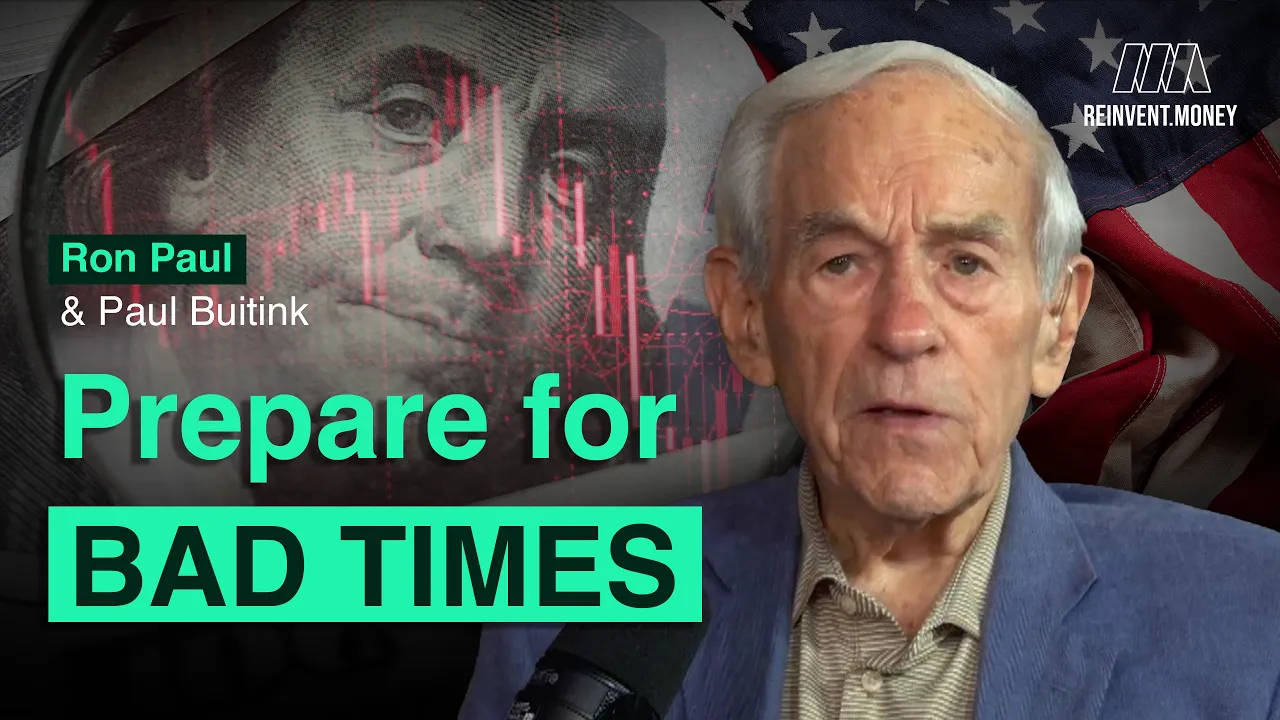
Paul Buitink of Reinvent Money speaks with former Congressman Ron Paul, recorded on US midterm election day. Ron Paul argues neither major party deserves to win because both back deficit financing, the Federal Reserve and endless war. He points to US debt rising from 11 trillion to over 40 trillion dollars, says inflation follows from printing money in Austrian economics, that new money reaches special interests first, and favours sound money tied to gold and silver. He expects spending, debt monetization and a panic out of the dollar, and ends optimistic about technology for spreading ideas of liberty.
Speakers
Topics
From De Week van Bitcoin; community: Reinvent Money.
Transcript
The spending is going to continue. The monetization of the debt is going to continue. Our wars are going to continue. And the uh value of the dollar is going to go down. And the value of our freedoms are going to go down. And that's a sad story for all of us. >> Do you think that was Trump's biggest mistake to to start the war against Iran? >> Well, I think you have a lot of choices. That that's a big one. million of people die at the hand of our foreign policy because it's uh the initiation of aggression. The uh secretary of treasury said we've checked it and the gold is there. I I don't believe that. I don't
think he he knows. Europe should be concerned about the uh limitation on freedom of speech. Prepare the best you can in preserving your wealth so that you can function under bad times. At the same time, read read and find out what the alternatives are. You have to have an alternative. Hello everybody, my name is Paul and welcome to Reinvent Money, a podcast about money and power. It is with tremendous pleasure and honor to announce today's guest, a true hero of mine and the number one reason I got interested in Austrian school economics and libertarianism, former Texas
congressman and libertarian icon, Dr. Ron Paul. Welcome, Mr. Paul. I'm truly honored to have you on. >> Thank you. Delighted to be with you. >> Yeah, thanks so much for making time available. Like I said, you were the main reason I got interested in uh during the great financial crisis in in Austrian school economics and the royal central banks, especially after reading your book and the Fed Classic. And um today we're recording this on the 3rd of of November, the day the midterm elections take place in the US. A very important moment of course. Uh but you said recently that Republicans deserve to lose, but Democrats don't deserve to win. Can you explain what you mean with that?
Well, you know, it's easy for me as a libertarian to not get too excited about either party. So, I I like to be fair and balanced. If I'm going after one, I like to make it, you know, universal and both both of them. And uh yeah, neither party has deserved it. It's not what I want. It's not what the constitution says. And uh yet a lot of people, you know, most of all the talk is over power, the power struggle. Who's going to have the power? Who's going to have the political power? Who gets to declare the wars without declaration? Who, you know, to get involved? And it's it's a it's a it's an issue over power. And so I see that neither side deserve it. and
maybe for a slightly different uh different reason but the point is is uh I don't think what what either side is proposing is uh you you know fitting into the rule of uh their oath of office of obeying the constitution. That's my frustration. >> Yeah. Yeah. You mentioned that it's basically a choice between republican corporatism and democratic socialism. >> Yeah. That is that is for sure. I think they neglect uh they talk about the socialism and the communism and uh the republican you you know the republican form of capitalism which I don't like because they get blamed for what we have
and what we have is corporatism and special interests and deficit financing. So I don't like to see the division between, you know, the socialists that have come in and uh they they justifiably criticize the Republican, you know, uh capitalism, which is, you know, a false charge. So they come in, but the Republicans just sit there and say, "Oh, no, no." And they they don't have an argument back. They don't argue back and say, "What we have is a mess." So, so we shouldn't we shouldn't say the solution is just throwing out one bunch of, you know, interventionists and planners and put in a new bunch. It doesn't make
a difference. And uh so the people who really defend freedom and sound money are outside the uh partisans, you know, uh the partisan battles that go on. I don't know whether that's true in every country, but that's what my assessment is of the United States is that uh they they there's really people kid Ron do you support the third party because this is such a mess in my com I'm wondering if if we could even have a second party you know because because you know even though there's a lot of differences the big things between the Republicans and the Democrats are are in an agreement I
mean which side is going to make sure they're going to do whatever they can to get rid of the Federal Reserve. No, they don't even talk about that. Which side is going to lead the charge to a balanced budget because it's going to cause a lot of trouble, a lot of inflation and uh and which party's going to do that? Neither one has claimed that. Which one is which which side is really will protect our privacy? you know is on and on that uh they uh they endorse uh intervention in the economic policy, intervention in our personal life, intervention in foreign policy that uh I think is so dangerous and that's how we go broke and violate the rights of other people and we end up with constant wars.
>> Yeah. And the same thing in Europe, they all want central banks, they all want the euro, they all want to um spend more money uh on the military. So it's it's basically the same picture uh on the continent as well. So interesting when I read your book uh and I read it again and it was written in 2009 the the public debt was 11 trillion and and you already mentioned that it's it was not sustainable. Now we're at over 40 trillion. Um so an immense uh increase over the past 17 years and the number one concern with voters is affordability, high prices, inflation.
Uh but with the US public debt at over 40 trillion, do you expect inflation to to pick up a lot over the next few years? >> Yes, it's it's not possible. You know, in Austrian economics, you can see what's happening in saying this will lead to trouble. If you print a lot of money, the value of the dollar goes down, prices will rise. But what you don't know is uh how fast it'll happen. uh which uh uh group will suffer the most. Uh there are some groups who will be hurt more from the inflation. So that's why it's so evil. People over the years have said to me, Ron, what what would be wrong with this system that the government just be restrained? They can
increase the money supply 5% every year or 10% and just take care of everybody. And uh and the the the whole thing is is uh the the uh money never gets dist distributed like that. Uh the special interest get the money first. The people who are borrowing trillions of dollars, they get to spend it and run up the investment. So there's no fairness about it because there's uh there's choices made. If you if you deliver tens of thousand dollars to a group of people and everybody's allowed to do what they want, they don't all do the same thing.
Some people might buy a car, some people might pay down their debt. So that's why it's not equal. You cannot say, well, the decrease the money supply and we'll pass it out and everybody will be treated. Labor could go up, prices could go up the same. So, uh, you have to leave it to the market. You have to have a monetary system that is reflective of the market. And that's why the uh uh the requirement for a sound system is you have to be able to define precisely the unit of account. And of course the founders understood that and that was to be able to name you know the percentage of uh or the or the weight of a gold or silver whatnot. And that's been taken away from us completely slowly and
steadily over many years. But it's gone now. And that's why the door is wide open because people have been almost conditioned. Well, you've been saying that for a long time and we're still doing pretty good and people take our dollars and they go on and on. So they've been addicted to it. So it's going to continue. So that's why I say the spending is going to continue. The monetization of the debt is going to continue. Our wars are going to continue and the uh value of the dollar is going to go down and the value of our freedoms are going to go down and that's a sad story for all of us.
>> Yeah. And do you expect the dollar to end in a sort of a deflationary debt spiral or more like a hyperinflationary scenario? >> Well, that's one thing. Again, I don't think people can protect it exactly, but uh I I know that uh most of the time when you get this far along uh they end up with a uh you know crack up boom. you know, people have to get rid of the currencies and uh right now we're not there, but there's a a degree of it because uh people people are trying to save money and work and and save themselves and that's why they uh you know and try to change their
investments but and and it doesn't work. But it is a it is something that you can't predict again exactly when it's going to happen. But I believe in the crackup boom where people panic out. Yeah, just think even in the last week or so there's been some manic p uh you you know minor panics and some people would say big panics in the stock and bond and AI markets. It's huge and I think it's just getting started because I c I keep thinking that a lot of this trouble we're facing now was those many years that we we said boy this is easy.
We just we just get we just have interest rates at 0%. You know that that's that's what we did for quite a few years. We had no interest rates. Interest rates are the most important price that people should watch when they're looking at the value of their money or any investment. And uh but but no, right right now people don't look at that. They're they're convinced it'll continue forever. But that's why I believe it's going to be continuation of the inflation and the def devaluation of the dollar.
>> Yeah. Like you write in your book, you usually dishonest money goes hand in hand with dishonest leaders and and you know the money has gone bad and a financial system is a mess. An abuse of power and abuse of money can bring a nation down. So all these things you wrote down a long time ago and they're are more applicable now than ever before. Well, you know, it's it's a matter of think, you know, assessing the history and the amount and how much influence because uh you might say where where were we or the the world was with the currency of Venezuela or Zimbabwe and and uh a lot of those Germany for instance a while back uh it went on and it defaulted and it was you know
destruction of the currency and they had to start Matter of fact, our continental dollar was uh you know destroyed the same way with the revolution. Out of desperation, they created more. But it was also a lesson to the founders that we should not depend on that system. And that's why they said nothing other than gold and silver could be legal tender. So uh and the whole system is so unfair because uh some people suffer a lot more. the average person uh uh you you know that has to do the shopping at the grocery store understand this a little bit better than others. But uh it's also a a message. People know now something's
wrong and the message is there. There the wars are too uh too too incessant and and that's taking a lot of wealth and also the uh the uh groceries, you know, costs are going up at gasoline and fuel and all this. I think Europe knows a little bit about that and uh that's calling attention. But I see that as an opportunity rather than a conclusion. And that's why I hope people get uh you know inter interested in the solution. And to me it's liberty, personal choices, you know, volunteerism, private property, sound money, and you can answer it. And uh you don't need to have
a whole lot of laws for that. I say why don't you try natural law? Natural law has been around for a long time. And then people most people accept it. What what is natural law? Well, it's a system where people agree they can they can't lie, cheat, steal, or kill. Well, that sounds reasonable. Most people believe that. A lot of people uh you know uh still do wrong and follow that. But the problem has happened is people still know a little bit about natural law. There's a lot of morality in the country and the world that people still treat it that way. and trying to live within a you know moral boundaries. But I'll tell you they uh they do this and uh uh the
big problem has been that we gave this authority to run the natural law. We we said the f the government doesn't have to follow natural law. So who does the lying? Have we ever heard of a politician lying? Cheating. Yeah. there's to say we have to we have to stay stop lying and cheating and and fraud and uh and and solve the problem but they don't even talk about the morality of it all and uh so if if people would just give up the effort of using force go to volunteerism and do that as a principle a moral principle and the world would be a different place
to live in and yet a lot of people would say, "Sounds like a pretty good idea. Why don't we do that?" Well, we've talked about that forever and uh it's a moral issue of trying to get people to never lie, cheat, steal, and kill and not let the especially not letting the government do it. >> Yeah. No, I fully agree with that. Uh so, ending the Fed, is is that still possible given the high public debt at the moment? because I can imagine that the Treasury needs the Fed basically in order to uh run their scheme or do you think it's inevitable uh and and it's always a good time to end the Fed?
>> Yeah, we're not going to end the Fed. People ask me if they put you ahead of the Fed uh what would you do? I said, "Well, well, you'd have to, you know, stop monetizing debt." I said, "But that would cause uh a civil war. You know, people couldn't adjust." And instead of saying it can't be done and give up on it, I say there's a way you could do it, I just don't believe it will be done. And that is, you know, set it up, have the people agreeing there's too much spending. We should spend only the money that we earn. We should define the currency and we should say as a gradual thing even make it gradual you know in cutting the spending take care of the
people have been ma uh you know uh made to live in poverty because of the welfare state uh take care of the people who are held the victims that uh can't uh even have food on the table and people are suffering. You could do that gradually and cut down uh what about cutting the military budget 2% a year. You'd think we could defend our country with a reduction of 2%. When you look at it, the money we spend has very little to do with our national defense. I'll tell you that it has to do with the pockets of the military-industrial complex. So my answer is you could do
it. You could set up a table where theoretically you could do it, but uh it wouldn't be tolerated. So that that excuse me, it wouldn't be tolerated and therefore I expect to have the crackup move instead. >> Yeah. And talking about military spending and and wars, um do you think that was Trump's biggest mistake to to start the war against Iran? Well, I think you have a lot of choices. That that's a big one. But, uh, how how you we might even start with Ukraine. uh we'd even start with tariffs and and on again and uh misleading people and there
but the war the war in Iran was the most deliberate and the most uh uh you know clearcut because uh he has his name written all over that war but it's part of the uh foreign policy that uh Republicans and Democrats agree with. They argue about it and you know even now the debate on assistance to Israel has uh evolved into something a little bit different than it's been essentially for a long long time. you wouldn't dare say. So Trump uh even in the middle of this event uh election day uh he's talking about you know it's time we ought to cut this uh this uh uh aid to
Israel that's too much there and Yahoo agrees with me. So but but what people don't believe that and so that's why I'm uh I'm uh working on an assumption that we should do two things prepare the best you can in preserving your wealth so that you can function under bad times at the same time read and find out what the alternatives be you have to have an alternative that's one thing you have to give the Marxist you know credit for they know what they want they want chaos on the streets that they want to actually elected communists and socialists. And you look around and today we may see just how strong they
are. >> The world is becoming more uncertain by the day. More and more investors are trying to find ways to diversify their portfolio. For thousands of years, gold has been used to preserve wealth during times of geopolitical uncertainty. In recent years, central banks have been increasing their gold holdings as part of their reserves. And now it's time to start building your own gold reserve. With the Holland Gold app, you can easily buy physical gold and silver. Start investing from just €10 or invest automatically with the Holland Gold Savings Plan. Join more than 100,000 customers across Europe and download the Holland Gold app. Investing involves risks. The value of your investment may fluctuate.
>> Yeah. And uh you have also always been a great uh supporter of auditing the Fed. um also alting Fort Knox. Your son ran to Paul went to Fort Knox the other day um saying everything was fine there. But when I read that news, I directly had to think about you because you've always been so adamant about a full audit of the Fed and and and Fort Knox. So do you think there was a a proper audit or or not? Well, the audits uh request of the audit and performing something is important just to call attention to it. But I uh I don't I don't think any of them if you
know if they come up well matter of fact the uh secretary of treasury said we've checked it and the gold is there. I I don't believe that. I don't think he he knows. I don't think there's been an honest office. I think there's a lot of promises. They load things out and they u if you want a really honest uh gold standard, you have to have gold coins. And uh you have you could use paper money, you could have gold certificates, but if you have a $100 gold certificate, if you take it to any bank, you ought to be able to get, you know, you have to have $4,000. Now, put your $4,000 down and they have to give you a gold coin.
that would be the case. So that isn't the case. So uh ending ending the Fed uh even putting restrictions on monetizing is going to disrupt things because they can't do it. It's impossible for them to manage interest rates because there's no way they know what interest rates should be. It's the most important price in the world. And uh but nobody nobody knows about it because it's it's established by the people, the investors, the savers, the people working, the people who grocery shop, they eventually decide what these numbers would be. But it has to be a sound currency and you have to have the currency uh as as a definable unit of
account. >> Yeah. But in the end, people should be able to choose their own currencies then, right? So if some people decide to to to use Bitcoin, others decide to use gold, then that's all fine with you. >> Yes. As long as there's no fraud. If there's fraud, if there's fraud, no, you can't do it. But but that's happened many times over history, especially after war. After World War II ended, there were a lot of substitutes and they were things, stuff that people would pass around. But the problem is that's drifting back to uh uh you you know just trading and uh uh bartering that's very very inefficient. So money is very very efficient minded if you have an honest
currency. That's the key to it. Uh and a question about um wars and and interventions. Is there any situation plausible in your mind where the US could indeed preemptively attack another country for example if you would have clear evidence that they indeed are developing nuclear arms that they could use against you? Is there a hypothetical scenario um in your mind where it would be okay to start a war like that? If it's hypothetical and they did initiate aggression against us, no, we wouldn't have any moral right to attack them. And that's all the argument based on why we have been fighting in the Middle East
and Ukraine and you know and uh Afghanistan. We have to stop these people. They're bad people. And uh no, it has to be self self-defense. I think I try to narrow it down to get people to visualize. Think about it as your house. People aren't you your your house is your castle. People can't come in. They can't knock on the door. They can't say, "Well, we have a couple immigrants here. They don't have a place to stay, so you have an extra base bedroom. We're going to stay." That's not what we want. We want to open up the doors and and let them come to our schools and all this.
So no, you you can't justify, you know, going to war unless they've attacked us. If the person come to your house and they're they, you know, knock on the door and they say, "Well, we're taking over." And they have a gun in their hand and they kick one of your kids in the face and knock them out, that's war. But uh other than that, you can't you can't uh uh uh do it because you know everybody everybody has it looks to me like when two sides have the nuclear weapons you're less likely to use them you know just think India and and Pakistan have weapons now and uh and
that's been the case United States uh after after the disaster of Hiroshima Nakasaki after that you know the Soviets had nukes and we had nukes and so it isn't the holding of nukes and uh I think that uh when it comes to all the wars that I have watched and I remember World War II uh and when you know the history but I can also understand why the people would get behind you know a war you know after Pearl Harbor but if you read the history of somebody if you know somebody with wisdom and a and and an education. They could have realized that our policies because
we uh we we prevented Japan, we put on a terror, we wouldn't let them, you know, uh uh trade and buy oil. So, we precipitate those things. But once the bombs fly, I don't know any way that you could say you can't retaliate. But that is a far cry from what we do with being in 120 countries and we're just lining up. When are we going to get to go to to Greenland? We want to go there and all all this nonsense.
>> Yeah. Um I'm based in the Netherlands in Europe. Uh France is on fire and there are lots of riots in different European cities. How do you look at Europe at the moment? any advice for us? >> Well, I'm I I could talk about Europe in generalities, just the way I think politics works. And uh I think basically I would expect Europe to have very similar problems that we face now. Maybe they're ahead of us in some areas. and uh and and the dependency of uh countries that go uh go towards socialism and peace and uh peace and meal at a time. Uh they become weaker and uh and then then the rich countries
are say well you better help us out. Then we get involved in foreign aid and all these things and to me most foreign aid is just stealing money from poor uh rich people in this country and giving it to poor people elsewhere overseas. So no all this is everything should be voluntary and we solve it all the problem. Voluntary means no violence to have your way. And uh that uh that is our problem because they they resort to the violence and uh I think uh I think United States is is the one that has the most weapons. We have the most uh uh you know nuclear power and everything else.
But but just no no aggression. don't start the war and uh don't start the fight and uh defend your family and defend somebody they if they come but that hasn't been been the case uh it's been a long time since we've had to deal with the British invading America so uh but where where have we been fighting you know how many innocent people have died over the last 10 20 30 years I mean thousands people say vote on millions of people die at the hand of our foreign policy because it's uh the initiation of aggress aggression and uh people have to realize that. So to me the ultimate test
is the people understanding the morality of a moral society that you can't can't commit aggression against other people. And most people will see, you know, they agree that's a you shouldn't be able to lie and cheat. That that should be illegal to do that. And why in the world do we beg the government to to be our henchmen to go and do all the stealing for us? >> Yeah. Now, great words of advice and and very important lessons, Mr. Paul. Thank you so much for your time today. And um I want to uh also um share with the viewers that of course you run a daily show on the Ron Paul Liberty Report in
YouTube and Romeo I think on on a daily basis you uh publish videos there. I like them a lot. So everyone just check out Mr. Paul's YouTube channel. Any other things you want to share with with us Mr. Paul? No, to me it's a moral and an educational uh problem that we have and everybody is invited to join it and this is where my optimism come in because I think the technology that can be used to do damage the technology today for you and I to talk you're not even next door you know we're not in the same room we're across an ocean and we're talking about liberty so I would say that uh you you know they are still very concerned ern about and
Europe should be concerned about the uh limitation on freedom of speech but I they can't control it freedom of speech the founders use pamphleteing we have some modern technology today that if people join in the effort to promote peace and prosperity and freedom uh the technology is there and the talent is there people like you Paul you're out reach reaching out to a lot of people it maybe 10 15 years ago or whatever I never dreamed when I was going through college or anything, I used to talk about this and I loved it. I'd go to college campuses because there was a small libertarian group and I get 15 20 people out, you know, I think, wow, there's a few people left. But today,
there's a lot more people listening. So, we should be uh depressed over the fact that we're not running all the TV station. Real information is going to come in a different fashion. >> Yeah, exactly. And I'm I'm truly honored and grateful that I have the chance to talk to you using modern technology and uh like when I was reading your books and your work, I couldn't imagine ever being able to talk to you like this for half an hour. It's it's insane and and amazing and inspiring and I love your positivity and it's always been the case with your message about anti-war and freedom and sound money. So yeah, keep on spreading the good words uh Mr. Paul and and thanks so much for having this opportunity of giving me this opportunity to talk to you.
>> Thanks for having me on. Yeah. Have a have a great day. Bye-bye.