Societal Intelligence and the Network State
Network State Conference 2024 · 22 Sept 2024 · 11:55
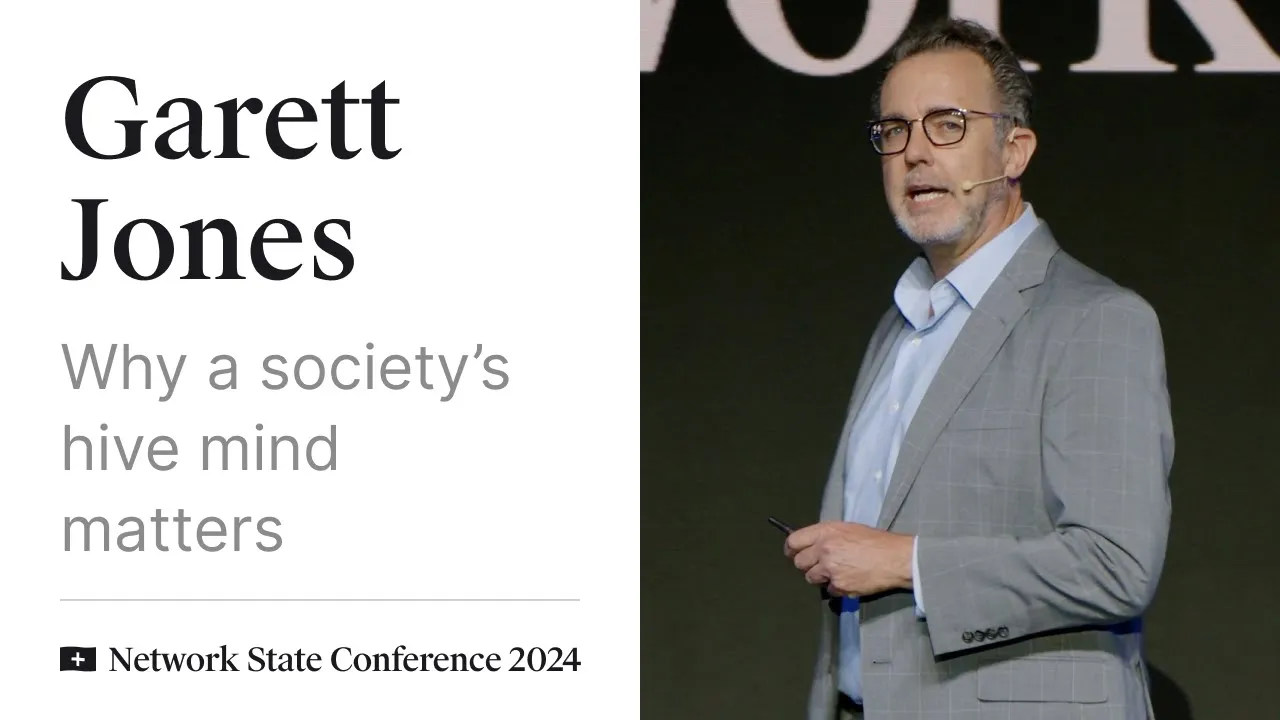
Economist Garett Jones, author of Hive Mind, explains why he believes being around smart people matters more than being smart yourself, and what that means for network states. He describes research suggesting smarter pairs of players cooperate more, and estimates that one IQ point matters about six times more for a nation than for an individual. He argues that elite-run institutions such as central banks often outperform populist alternatives, makes his case for 10 percent less democracy, and says migrants tend to keep their home norms. His advice: recruit excellent founders and talent.
Speakers
Topics
From Network State Conference 2024, hosted by Network School.
Transcript
well once upon a time I was a Mormon missionary knocking doors and sharing the Gospel of Jesus Christ and then one day I decided I didn't believe in it anymore and so I quit and I went home but I carried some important lessons from my experience being raised as a Latter-Day Saint one was just this incredible admiration for this successful pro-social culture mostly built in the wilderness of a very wild and Savage Utah and that success is something that I carried into my research into government and governance if uh I could find paths to replicate even a small portion of that for a broader world that would be a success uh later I decided to
get a PhD in economics I studied at UC San Diego where we have that fantastic Library um paid for by the funds of Dr Seuss in great part um my dissertation was on the Federal Reserve so I learned a little bit about the monary system worked in the US Senate and somehow had the great Fortune of being hired at George Mason University to be an economist and there I'm surrounded by people who use the economic way of thinking to address creative questions that have already improved the world and I think will continue to improve the world even more so my first book in my Singapore Trilogy um is built on my decade of pre-tenure research uh into why being around smart people is more important than being smart yourself uh
some people warned me hey you don't have tenure don't do this work on IQ wait until afterwards um but I decided I wanted to sort of challenge Academia in a way I always knew I could find something else to do um and that was a fantastic experience uh but ultimately after publishing these articles I decided to turn it into a book and uh one great uh my favorite finding in all of this is that uh it turns out that smarter groups really are more Cooperative in game theoretic settings uh most of you here are familiar with the prisoners which is an important cooperation game and it turns out that smarter pairs of players are more likely to cooperate in this game um I found this in some research with my colleagues it's been replicated at other labs and then in other
cooperation type games um it turns out that smarter pairs of players not smarter individuals smarter pairs of players are more Cooperative smarter individuals they can be quite Mackie of alion and quite cynical but smarter pairs of players when placed into a game bring out a sort of what you might call Machiavellian cooperation a cynical form of cooperation based on self-interest and thinking about the future a form of think win-win so that's what's going on in the lab what shows up for Nations as a whole is that according to my early estimates which have been confirmed by others in various methods uh it looks like one IQ Point matters six times more for a
nation than for an individual so it really is more important to be around smart people than to be smart yourself and I think these are both lessons for any state virtual or real or something in between which is that intelligence is a form of social intelligence and intelligence is a driver of social cooperation both of which are crucial for Quality governance so uh it took a while but eventually uh the World Bank created went through the great effort of creating uh Math Science and reading School assembling them assembling various databases making them comparable so that we can come up with something like standardized International test scores so they can be compared across countries
and this map is a map that looks like a lot of other Maps you see of different outcomes around the world um and for for instance GDP per capita here I picked one that summed up in terms of years of education this is the world bank's estimates of this uh turning test scores into years of education as a proxy and the for me the lesson is that we all know there's some reverse causation here we know that when you get richer you can afford more education when you get richer You country can afford more quality education my story is that much of this causation is forward causation because smarter groups of people create a more powerful productive hive mind I think that's an important lesson for the network for any network state that is created in the future and all Network
States anywhere along the Continuum virtual to real in my second book uh 10% less democracy um I argued that basically oligarchy is kind of underrated and democracy is kind of romanticized uh and I didn't just draw partly I drew on my experience working in the Senate where we all saw that Senators become sort of political cowards and their last two years before when they're coming up for re-election US senators have six-year terms and um we all had a term that we used in the senate for when a senator was less than two years from re-election we said that he or she was in cycle and we all knew they'd be pandering to the voters back home so four years of thinking of big issues and Grand National strategies
first four years last two years um worrying about the voters back home um so this was just an anecdote that we all saw it turns out that uh rigorous research shows for instance that senators are a lot more likely to vote for free trade agreements with the further they are from reelection uh turns out that Hillary Clinton for instance when she was first a senator she voted for every free Trade Agreement in her first four years of her first term and voted against every Free Trade Agreement in the last two years when she was coming up for re-election that's one illustration of this broader Trend uh that fits in with uh the view of views of my GMU colleague Brian Kaplan that voters want a lot of bad things and politicians sometimes give those bad
things to them um but also I drew on Research that was broader than just looking at the Senate um we'll see some of this later uh whether we're looking at uh judges whether we're looking at central banks it turns out that small groups of Elites sort of various oligarchies seem to be an important way the government gets run today and they actually are relatively functional especially when you compare them to the non-utopian alternative I'm sure that the five fa your five favorite follows on Twitter the five people on Twitter you like the most I'm sure they would be better at government than the ACT existing government that exists but that's not
what's on the menu what's on the menu is for most cases Elites versus the masses um so uh modern research here really backs Aristotle I'm sorry his full name was cut off there um but uh Aristotle argued that the best forms of government were some kind of blend of democracy with oligarchy he used the term poity for that and modern research I think finds some evidence for that we might be on the wrong side of the Democracy la eff curve um at the very least the romanticization of uh voter influence it's time for that to weaken and I think for Network States as well thinking about the fact that many important decisions will and should be
made by small groups of well chosen Elites even small groups of mediocrely chosen Elites might be better than the masses that actually exist so um my uh third book is called the culture transplant um and my lesson there is that uh migrants ultimately never fully assimilate on average uh the grand historical versions of this that have been studied almost too obvious to mention when Europeans moved to North America very violently uh they did not assimilate to the productivity Norms to the cultural norms to the agricultural practices of the re of the Native Americans who were already there that their assimilation was there was no
essentially no assimilation at all um but to speak of southeast Asia the Chinese diaspora brought some of the grand values of the Ming and Ching dynasties across southeast Asia and are now currently often and in both academic and non-academic settings referred to as Market dominant minorities again a generalization true on on average many exceptions but they have brought a lot of high productivity exceptional economic excellence and trade networks that are extremely valuable and that have been heavily studied um and that is a case where again they did not assimilate they may have assimilated in small moderate ways perhaps in language perhaps in some sort of minor cultural practices uh but Norms of
productivity practices of uh business and these important trade links between uh across the Chinese diaspora have all persisted and did not dissolve into local assimilation so um this another less dramatic version of this has been studied quite a few times dozens of times much more than the other stories uh here where I'm thinking about uh the Harvard's alisan UCLA's Pao Giuliano finding that on average migrants don't assimilate they carry a lot of values from their old country to their new that italian-americans are a lot like Italians in Italy today it's been tested multiple times so these books are my Singapore Trilogy uh Singapore is a
nation with high average test scores a lot of technocracy and they illustrate the success of the Chinese diaspora so um some quick lessons on the trilogy first get smart bring in smart folks second um another lesson of the network State for the network state is that Elite central banks often do quite well compared to more populous central banks this uh paper by Larry Summers Albero Alena kicked off a huge literature finding out that elite elite run central banks may have their problem but they're a lot better than the Democratic alternative and um to me a lesson that we should all take away for the network state is that
excellent Network States across their many forms will contain excellent Founders excellent oligarchs and excellent migrants we often like to hope that that um we often like to hope that if we have problems in our society if we problems have in in a in a state we can fix it through education through cultural change that is internally created instead I would like to offer the possibility that one of the great ways to solve your society's problems is to bring in people who are better than the people you already have import Solutions through better folks if you think that your savings rate is too low in your country one
solution sure bring in um you can try cutting taxes you can try regulatory reform or you could invite people who have historically come from cultures that have extremely high savings rates so um the one lesson I would that I hope you all take away is that uh Network States face the same problems as other states they need smart individuals who will be vote who will participate either informally or formally in the governance of the organization and smarter groups on average are more Cooperative that is too important a channel to ignore um uh if you look here I have uh links to free chapters of each of my books made available through
Stanford University press and I hope that uh as people build Network states of various diverse kinds they remember that they remember that hiring a hive mind is can be done by bringing in the best folks possible you should staff your hive with the brightest and finest Minds thank you