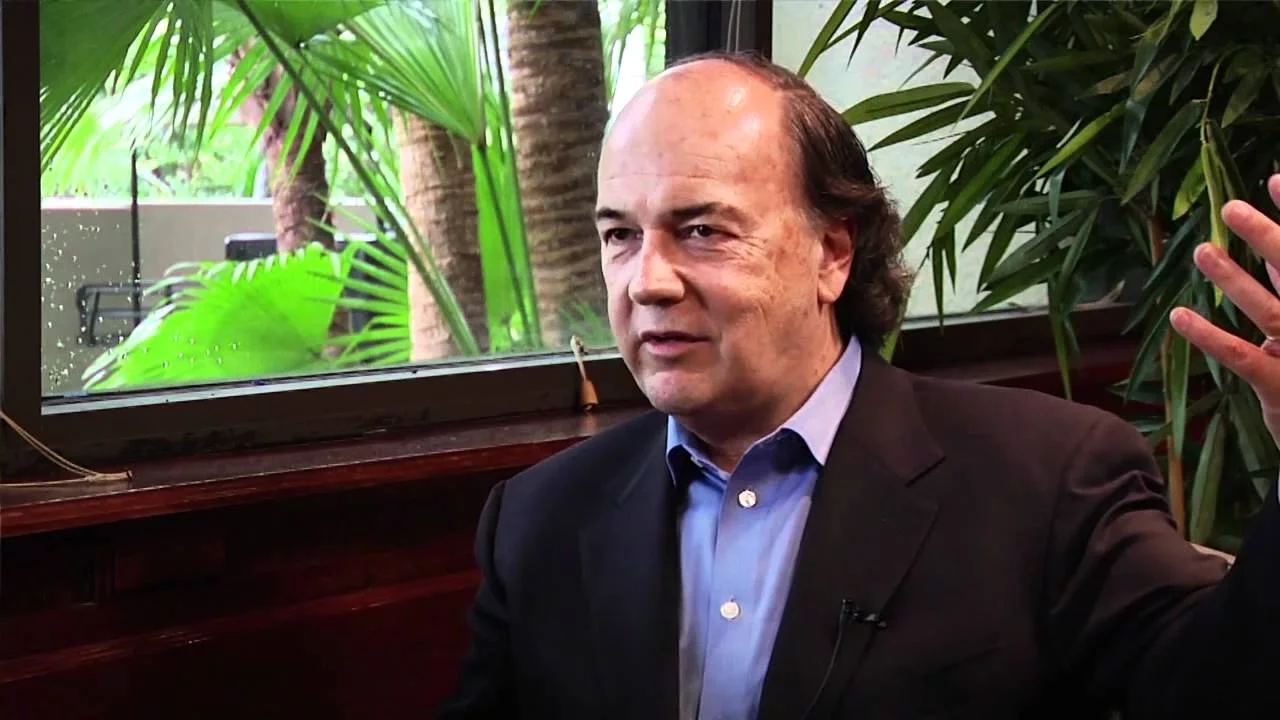
Gold, competing currencies and the Fed
De Week van Bitcoin · 31 Mar 2016 · 31:31
Jim Rickards, author of The New Case for Gold, talks about money, gold and competing currencies. Rickards says he regards gold as money and would favour currencies linked to gold, compares the dollar, euro, gold, silver and Bitcoin to horses in a race decided by confidence, and argues that by his own calculation gold would need a price of at least $10,000 an ounce to back the money supply without deflation. He also gives his view of the Federal Reserve and the chances of a US recession.
Speakers
Topics
From De Week van Bitcoin; community: Reinvent Money.
Transcript
hello everybody Welcome in a new episode of the reinvent money hangout I'm your host Paul and my coost is lecturer and Economist y Burgers our special guest today is no one other than Jim Rickards author of bests sellers currency Wars death of money and now the new case for Golds Jim warm welcome to you welcome Paul and Yan great to be with you thank you right so let me just uh start with um with a few simple questions possibly um if you choose between going back to the gold standard or competing currencies what would you choose well uh I think of gold is money so to me a gold standard uh is a formal currency you know the um there's a lot of confusion about gold standards every
gold standard is just a relationship between physical gold and some money supply I don't uh I don't expect people are going to be walking around with gold coins in their pockets maybe you know if there's a a breakdown of society a breakdown of critical infrastructure that may happen but I don't necessarily uh foresee that uh but just a normal gold standard you'd still have paper money or digital money it would just be backed by gold or linked to to gold at some basis on some basis you know we had a gold standard the pound sterling was backed by gold in the 19th century the US dollar was backed by gold through most of the 20th century obviously up until uh 1933 or 1971 depending on uh whether you're talking about US citizens
or trading partners so uh I don't think it's an either or do you have a gold standard or do you have another currency the question is have all the currencies you want but have them backed by gold uh as was the case under Breton woods and as was the case in the 19th century without the benefit of Breton woods and that a system like that could work fine um keep central banks from inflating the currency uh keep money honest Inspire confidence uh and I think would be an improvement over the system we have today but what if people want to just want to use their own currency are they allowed to compete with um with with the gold backed currency or what's what's the situation like in terms of um individual liberty and uh and the possibility to to transact in your own
um currency backed or not backed by gold well look anything can be money at various times in history uh feathers have been money uh shells have been money um dollars Euros are money Bitcoin is money gold is money silver is money so there many many kinds of money um people say they're not backed by anything you know bitcoin's not backed by anything the dollar is not backed by anything but that's not true they are backed by one thing which is confidence if you and I have confidence that something is money and we agree that it's money then it can be money so the question is uh sure you can come up with your own money you can have some Paul money or some Yan money and you know put your face on the paper and print it up and hand it out the question is will
anyone have confidence in it maybe they will maybe they won't same thing with Bitcoin same thing with gold and so um the question is what is money money is any medium of exchange unit of account or store value that the viability of which is determined by the subjective preference of the people who use it or as to use it so I can call something money but if nobody else in the world wants it then it's not very uh very useful as money uh one of the attractions of gold of course is that it's always in demand it's always acceptable it's always been a good form of money it's not the only form of money by any means so uh I have nothing in principle against anybody inventing any kind of money they want the only caution I would would raise is what are you doing to inspire confidence in your in
your private money right what do you think are oh sorry Paul uh what do you think are good competitors to to gold as a currency do you think silver is a good competitor do you think Bitcoin would be a good competitor or do you think there are no competitors well no I think competitors is a good way to put it so think of it as a horse race you know like the our Kentucky Derby uh you've got 14 horses lined up in the paddock and uh you know they open open the gates and they all run around the track and see who the winner is so the horses are you know the dollar the Euro the Yen the Yuan gold silver Bitcoin other cryptocurrencies uh you know UK Sterling these are the competitors so who's going to win the
race well that would be uh based on the subjective preferences of users of money people who need money or want money or have a use for money are going to decide indiv individually which ones they have confidence in and how they will subjectively value them so that's how money gets its usage or gets it its um as they say inspires confidence or gets gets put into use now governments have a little bit of an edge because they this is now um you know German monetary Theory but um also uh called chartalism uh uh which was adopted by advocated by John man kees governments have an edge because they can make you pay their their taxes make you pay your taxes in
their money so the US says we'll take dollars in payment of your taxes so taxes are imposed by government the US government says we'll take dollars to if you want to pay your taxes but we won't take anything else I'm a US citizen I pay us taxes if I try to pay my taxes in gold silver or pound sterling you know the IRS will uh will you know laugh in my face they only want dollars so governments through the power of taxation have the ability to create some utility for their own currency because they make you pay taxes in it uh that's not the only use for money and you can have multiple forms of money I could pay my taxes in dollars which I do but try to use gold or silver for other types of
purchases so you know it's a like I said it's a race uh there are many entrance in the race a lot of horses in the horse race they're all competing for um you know as they say the preference of users of money for confidence time and uh and uh usage and you may the best currency win that's interesting that you referred to German Theory and I think the modern money theory is kind of Reviving this charless point of view where you say where where they state that taxes Drive money it's also like he Minsky once said that everyone can create money but the problem is to get it accepted and of course the state um just like they did in old times with the with the T stick for example in in in Britain that the
state first spends the currency into circulation and accepts back um for for taxes and that's of course puts ensures that there's a lot demand for that type of currency so um do could we ever go to like a proper competing Marketplace for currencies if governments have that advantage of of uh making sure that there's always this demand for its own currency sure I mean uh yeah why our Germany 1922 uh Zimbabwe 2000 Argentina 2000 Venezuela there many you know those countries print currencies and they collect taxes and they accept the currency uh in those uh to in payment of those taxes and yet not withstanding
that uh government power and coercion uh confidence is lost in the money there's Capital flight Capital outflow hyperinflation so U just because governments have a monopoly on printing their own money and a monopoly on Taxation and use one to support the other it doesn't mean that it always works if confidence is gone it's gone on so you'll take the money and get into you know you might keep a little bit to pay your taxes but you'll get into some other form of currency um I pay my taxes and dollars but with my after tax money if I want to buy gold that's up to me yeah uh interesting and um you also put a few um arguments in in your book that a lot of anti-gold folks would use to support the argument against Golds like
for example that the gold Supply isn't flexible enough or it can't increase fast enough to support World growth what would you say to those people well that's a that's a good point I cover it all in my book uh the new case for gold uh most of the book is uh prog gold arguments reasons to have gold including some new ones which we can talk about but before I get to that part of the book I actually take these anti-gold arguments and I demolish them part of the reason I wrote the book it's it's clearly educational I'm not a I'm not a gold salesman uh you can't buy any gold from me I don't get any commissions on this but but I wrote the book for educational reasons but I I was sick and tired after years of talking about gold writing about gold of hearing these
arguments against gold that were not true now people believe they're true they've been miseducated or brainwashed or conditioned or uneducated is the case may be on the topic and they hear these things they sound good and they repeat them but they're not actually true so let's just take the one you mentioned uh Yan which is um there's not enough gold in the world to support world trade and commerce so this world trade and commerce their bank balance sheets assets on Banks and people look at this big pile of money and credit and they say there's not enough gold to support that uh that amount of Commerce well it's not there's always enough gold there's always enough gold it's just a question of price in other words at $1,250 an ounce which is about the current price if you took all the gold
multiplied it by $1,250 an ounce uh that result would not support the money supply we have you'd have to decrease the money supply to maintain that parody which would be highly deflationary and probably depression it would be an enormous blunder but if he took the same gold and valued it at $10,000 an ounce and did the multiplication there would be plenty of gold to support World Commerce so the issue isn't whether there's enough gold the issue is can you get the price right that was Churchill Churchill's mistake right Churchill's blender 1925 and actually the guy who told them the guy who told Churchill to have a higher price was John Manor keing yeah mayor ke is always cited as this gold Basher but
ke actually understood gold very well Churchill wanted to go back at you know the the Sterling equivalent of $20 per ounce and Keen said no that was the price before World War I you you know the bank of England doubled the money supply to fight World War I so if you want to go back to the gold standard with that money supply you've got to double the price of gold make it you know say $40 an ounce Churchill ignored the advice went back at the old price they had to cut the money supply in half to maintain the parody and that put the UK in depression four years before the rest of the world so and Churchill later admitted that was the greatest blunder of his life but the Keen said make don't make gold $20 make it $40 today um I've done the math by the way when I say
$10,000 gold I didn't make up the number I'm not trying to get attention or headlines I don't care about that it's I've done the math I know what the goal I care I care about headlines okay I know what I know what the gold Supply is I know what the money supply is I know what uh banking fraction Reser banking is and the answer is you've got to put gold in a range of at the low end $10,000 an ounce at the high end $50,000 an ounce depending on whether you're you're trying to back up M1 M2 M3 depending on whether you're trying to use 40% backing or 100% backing those are all policy questions that people can legitimately debate but just using M M1 which is narrow and 40% backing which is kind of low you get to $10,000 an ounce uh that's the implied non-de
deflationary price of gold in a gold standard so uh again I I see gold going there because there's no Central Bank in the world that wants a gold standard but they may have to have a gold standard to restore confidence in some future Financial collapse and when you do you're not going to repeat Churchill mistake of 1925 you're going to get the price right the answer is $10,000 but the physical Supply is no impediment the other thing people say is well the supply of gold does not grow fast enough to keep up with the growth of world world uh the world economy so for example mining Supply the supply of gold for mines relative to the total stock grows about 1.6% a year and World growth you know it varies but it goes sort of
between three and 4% a year and people say well if Gold's only going up 1.6% World growth is going up 4% you know the gold can't keep up and that's gives the world a deflationary bias that analysis is complete junk it's complete nonsense because it mining output is irrelevant there are 180,000 tons of gold in the world only about 35,000 tons are held by central banks and finance Ministries to back up the money supply uh if they chose to so if you want more gold you don't have to wait for the miners to produce it and is deflation deflation bad anyway I mean that's that's also the question you have to ask yourself before like is is do we care if prices go down um and if we don't care then any amount
of gold would Service as long as we can divide it in small enough quantities digitally to in order to pay for goods and services well that's true and uh you know deflation is good for Citizens bad for governments but you're fighting the governments on this but I'm just trying to take the argument off the table in other words sure if if gold did not grow fast enough you'd have a deflationary bias and deflation is good for consumers I agree with that but my point is that the mining output is not a constraint you can have all the gold you want just buy it from the private sector governments can print money buy gold add to their official gold Supply and then in the process of doing so obviously they expand the money supply it's just like printing money to buy bonds which we do today except in the future you
would print money to buy gold and again there would be no limit on the money supply so there's no there's nothing inconsistent about a gold standard and discretionary monetary policy in fact through the 20th century you know the bank of England and the Federal Reserve had both at once we had a gold standard and discretionary monetary policy so this argument that mining output is a factor it's not a factor that's an irrelevant argument so I kind of go one by one and point out how all these arguments are fallacious and then where are all these arguments coming from because so this is an interesting point you mentioned earlier as well that all these central banks they're you know they're all hoarding hoarding gold but there seems to be this very negative attitude uh well maybe not a let's just say not a very positive
attitude towards gold at least along a mainstream economists but they're the same people that are also populating the central banks so where's how do we explain this well if you had that much power would you give it up voluntarily in other words the the phds the finance phds from MIT Harvard University of Chicago Stanford and and Yale who populate the central banks not just in the United States but around the world I mean Mario dragi went to MIT uh ji and Yellen studied under Stan Fischer who's the vice chairman of the FED all the it's a very small group of people it's like a PhD Club including Rajan who's the governor of the Central Bank of India um governor of the People's Bank of China they all went to MIT or Harvard they were each other's classmates each
other's thesis advisers they're running all the central banks in the world they're the most powerful people in the world they have invested interest in disparaging gold and making you not think about gold or mis educating you about gold because they want a paper money standard that they control anyone who controls the money controls political power controls the economy controls people's lives that's the funny thing they dispar gold on the one end but on the other end most central banks have gold as one of their M uh main assets so in a way we're on a sh gold standard but they're at the same time criticizing their own investment policy as it were because you cannot just say gold is bad on the one end and on the other end keep it as one of your main assets on your balance sheet right
that's right I talked about that in my book the new case for gold you know it's available on Amazon right now I explained look the United States has 8,000 tons the IMF has 2,000 tons Germany has 3,000 tons China has at least 4,000 tons perhaps a lot more Russ has bought a thousand tons in the last six years why are all these central banks hoarding and buying gold if it has no value exactly yeah and how do you look at these developments around people's QE because QE obviously isn't working as much as U the governments want at the same time we see a lot of different movements across the world that are advocating for people sky and they even central banks now saying yeah we should
start giving access to Citizens trade to the central bank in Ecuador for example as a citizen you can already open an account with the Central Bank The People's Bank of China China talks about it England talks about it Holland talks about it I I don't think we're that far away from citizens being able to open an account with the central bank and have access to Central Bank Reserves or digital cash as it were which would be possible then for for people's QE to to flow towards how do you how do you see that um that development and what is your view on on on on these things well it's definitely coming I mean it all people's QE is sort of Jeremy Corbin's uh term for it he's the the leader of the labor party in the UK
uh but it's really just helicopter money um uh we called helicopter money in the US we call uh people's QE in the UK uh the thought leader on this is ader Turner who is uh the head of the institute for New Economic thinking that's a George Soros back Think Tank Dar Turner has a book uh it's called between debt and the devil he refers to something called debt pollution uh debt monetization it goes by different names but it's all the same thing and basically what what it means is like the way the way we try to ease now and it doesn't work but the way we do it quantitative easing so the the Central Bank goes out calls up a commercial bank or a dealer and says I want to buy 10year treasury notes and the dealer
sells them the notes at a price and then the Central Bank pays for it with money that comes from thin air so I'm the I'm the Federal Reserve I I buy treasury notes from the dealers and I pay for the treasury notes with money that comes out of thin air that I just print but the problem is the bank now has the money because they sold me the bonds they take the money and give it back to the Federal Reserve they give it back to the central bank and it sits there in the form of excess reserves so the money doesn't get spent it doesn't get lent it doesn't get doesn't create velocity it doesn't turn over it doesn't add to aggregate demand it doesn't do anything all it does is suppress interest rates enrich Bankers deprived savers and uh you know Theory creates some kind of
Channel portf what they call the portfolio Channel effect to get people that just creates asset bubbles so that's the way that's the way quantitative easing Works helicopter money is a little different you start with fiscal policy so the government just spends the money they can give it to people they can spend it on Medicare Medicaid Social Security welfare programs education the environment or they can spend it on defense or infrastructure highways Bridges whatever the bottom line is the government spends the money that increases the deficit the finance ministry or the treasury then issues bonds to cover the deficit and the Central Bank buys the bonds thereby monetizing the debt so you're combining fiscal policy and monetary policy fiscal
policy to create larger deficits and more debt and then monetary policy to buy the debt that's called debt monetization now in theory you're still printing money but now the money at least is getting spent it's not being deposited back in the banks uh that in theory creates agrate demand um let's see um I think that's just you know increasing your debt to GDP ratio putting you further down the road to the path of Greece destroying confidence making but Greece can Greece can issue its own currency the states uh that they can they're buying up their own bonds with their own currencies so in a way they in in nominal terms they will not default because they're always able to buy up their own bonds but with their own money but Greece of course is in a different situation where it cannot it's
basically on on a gold standard but then uh in Euro terms sure uh but but the fact remains you can still run budget deficits and spend the money to try to stimulate the C now you're right Germany is standing in the way of them doing that but in the in theory any country in the world including Greece or you know particularly United States uh can run budget deficits assuming you know Germany's not squashing you uh but the point is you know certainly the UK bank of Japan Russia China the United States Canada all have degrees of freedom to do this China's talking about it you know they call fiscal stimulus but as long as the Central Bank monetizes the debt then U you know you still the money gets spent and in theory it helps the economy but uh I'm very doubtful that that's the
case I'm not sure the multiplier is really there and the uh destruction of confidence in the bond market and the currency as a result of the increased in debted and higher debt to GDP ratios may do more harm than good how damaging do you think what do you think uh the situation is currently at Central central banks so central banks are of course a bit different than uh than regular Banks but if you look for instance at the balance sheets the the the the sort of uh uh the um liability side has exploded in you know let's say the last uh few years or so what what what's your what's your take on this what what what's the health of
our central banks at the moment well I I'll use the Federal Reserve as an example that's the one I'm most familiar with although the same basic story would be true at the bank of England the bank of Japan The People's Bank of China and the ECB all the major um economy or economic grouping uh central banks so um a typical bank is Leever good healthy Commercial Bank is leveraged about 12 to one under us law a broker dealers leveraged about 15 to1 uh a good private Equity Firm might leverage six to1 a hedge fund might lever 3 to one the Federal Reserve has leveraged 113 to1 right so all the other ratios you know 12 you 12 15 uh whatever to one the the Federal Reserve is leveraged 113 to1
with a serious asset liability maturity mismatch so the FED looks like uh a really bad hedge fund I talk about this in uh in chapter one of my book uh the new case for gold I describe the fed's balance sheet and I um I speculated that if you took the bond portfolio and marked it to Market at certain times not all the time it depends on the level of interest rates but certain times the FED would be Tech technically insolvent and I I identified uh times like that now I spoke to one of the members of the Board of Governors one of the FED Governors about this and this person told me first denied that they were ins solvent and then admitted they might be and then finally said well what difference does it make um in other words central banks don't need Capital I'm not so sure
that's true in a crisis of confidence they might very well need Capital but the point is in uh then I talked to another I I talked about this in the book in chapter one of the book I spoke to another fed Insider uh not a member of the Board of Governors but actually somebody who's even more of an Insider one of the closest advisers to Ben beraki and Janet Yellen and he was very adamant very firm with me that the FED has never ever been insolvent regardless of the mark to Market on the bond portfolio so that forced me to go back and examine my assumptions look at the balance sheet and see what I might be missing and I discovered that the first line actually on the FED balance sheet is a gold certificate um and uh that was given to the Federal Reserve because the
treasury confiscated the gold from the Federal Reserve back in the 1930s uh but the treasury is a is the government and the Federal Reserve is a private institution and under the Fifth Amendment to the United States Constitution it's unconstitutional for the government to seize private property oh okay that's interesting without giving compensation so the compensation that was given was this gold certificate backed up by the treasury that the FED still has on its balance sheet now here's where it gets interesting they value that certificate at $42 an ounce $42 an ounce of gold now obviously gold is $1,250 an ounce that's historic cost accounting because it was $42 an ounce the last time they marked it to Market
but take the the dollar value on the balance sheet divide by $42 that will give you the number of ounces I converted that to tons and lo and behold it came out to almost exactly 8,000 tons which is exactly the same amount that the treasury has the treasury has 8,000 tons so it's clear that the US Treasury cannot sell any more gold because the treasury needs the 8,000 tons to back up the 8,000 tons that the FED says they have on their balance sheet so secretly and if you actually Mark that to Market Mark the gold to Market and add it to Capital it turns out the FED is only leveraged 13 to one so the FED looks like a very healthy Commercial Bank with a very decent Capital base and a very decent uh leverage ratio if if you count
the gold at the market so the FED is being propped up by the gold no one will talk about this no one will will admit it but the soleny of our Federal Reserve is propped up by gold uh held by the treasury but nobody wants to talk about it yeah um for just a quick message to the the viewers out there um thanks so much for listening to this episode and also uh supporting our Channel please like the video and subscribe to the channel um J Jim um I know you're only half an hour so we already kind of need to wrap up but you said something interesting uh also in the book that there's this new argument from gold that wasn't there back when the original case for gold was made uh which relates to our Digital World could you elaborate on
that argument of it sure uh you know the title of the book is the new case for gold and a lot of people have said well what's new about it I mean the arguments pro and con about gold will be going on for decades or maybe even centuries what's new well there are some things that new I do I do talk about the old arguments so I go through all that in the book but one of the new arguments there's several but one of the ones I found most compelling is that um Vladimir Putin has a 6,000 member cyber Brigade uh these are not criminal hackers these are us uh Russian uh military and intelligence assets working night and day to hack disrupt delete destroy and erase all digital banking financial and capital markets records so you could tell yourself you know I've
spoken to billionaires who say well I I own stocks and I own bonds I own this and I I own that and I say no you don't you don't own stocks and bonds you own electrons all of your weal is digital and if it's erased you have no wealth at all you're wiped out and that could happen in a heartbeat and don't think it can happen people think when I say things like this people think it's you know science fiction or making things up no just last week Bangladesh one of the poorest countries in the world lost a hundred million that they had deposited with the Federal Reserve Bank of New York it wasn't um you know deposited in some Bank in Sri Lanka or India or Bangladesh it was at the safest Bank in the world the Federal Reserve Bank of New York and the $100 million simply
disappeared uh the point I make that can happen to you so you need to have some of your wealth in physical tangible form and I like physical gold you can't hack it you can't erase it you can't delete it Vladimir Putin cannot get to it if Bangladesh had had gold they'd still have their $100 million today so I don't recommend going all in I'm not saying sell all your stocks and take all your money out of the bank and go 100% to Gold I don't think you should be 100% in anything but a 10% allocation of your investable assets will preserve your wealth and it can't be hacked or erased so we weren't talking about hacking and erasing and cyber Financial Warfare on the internet we weren't talking about that you know 10 20 30 years ago this is a new 21st century reason to have gold
in addition to all the other reasons and again would you still would you still advise people to own some Bitcoin as well uh well no I mean Bitcoin is digital if you if power grid goes down your Bitcoin are worthless so uh I don't uh I'm not anti- Bitcoin but I see it having a lot of the same vulnerabilities but but physical gold does not have the disabilities of Bitcoin and um and digital currencies like the dollar yeah and then we're in the political year I think you had a final question for Jim before we wrap up about us politics maybe you can drop that sure yeah I was Cur I was curious Jim what do you um so I I I think you predicted that there would be a recession this year I think we're already seeing maybe some of the
signs of that uh coming uh what kind of consequences do you think think that's going to have on the US uh election cycle that we're currently in on the presidential elections do you think and how do you think the different candidates might respond to a financial crisis what are your do you have any preferences um well you know every every forecast is conditional and I use uh inverse probability and base theorem so you're constantly updating you're absolutely right before December in anticipation of the Fed rate hike which I said they would hike in December after having said through all 2015 that they wouldn't hike remember last back to March June September 2015 Wall Street was saying the Fed was going to hike rates and I said they wouldn't but in December I
said they would I also said it would be a blunder and it would uh um cause markets to collapse and that's exactly what happened in January and February but then the FED got scared uh and obviously they're being extremely doish now but um the point is uh the recession forecast was based on the FED sticking to their rate hike path which they laid out in December which is 100 basis points per year but Janet Yellen is a very well-known liberal uh Democrat she's a democratic labor Economist and uh the people around her you know L brainer and mentors like Bob Rubin others they're all liberal Democrats so uh I call her a pod person now because they obviously got to her and switched her brain um and she's being extremely doish right now so I think her doish is
to help the Democratic candidate uh because they realized that if they continue to raise rates they would put the US economy into a recession I still think there's a good probability of a recession but if we don't have one it's only because the FED backed away from their own tightening policy probably for political reasons to help the Democrats okay Jim where where can people um find and uh buy the book thank you uh you know the book is called the new case for gold it's available right now on Amazon so uh just go to amazon.com it'll be in book is in at least in the United States uh next Tuesday April 5th but you can order it right now um on on Amazon I hope people
get it and I hope they enjoy it great and has a has a great review also from Ron Paul right correct yeah perfect any any closing remarks from your end Jim no it's an ongoing story and again I wrote the book really for educational reasons like I say I'm not a gold salesmen uh but I wanted to knock down the arguments against gold that don't hold water I wanted to lay out the case for gold and I wanted to include new matter that is that's why we call it the new case for gold because there are 21st century reasons to have gold don't have all your wealth in digital assets because it can be frozen or wiped out in a heartbeat yeah or do like me a little bit of digital assets a little bit of gold and you're fine I think that's right okay
great thanks Jim and let's do it again when your next book is at thank you very much okay bye bye bye