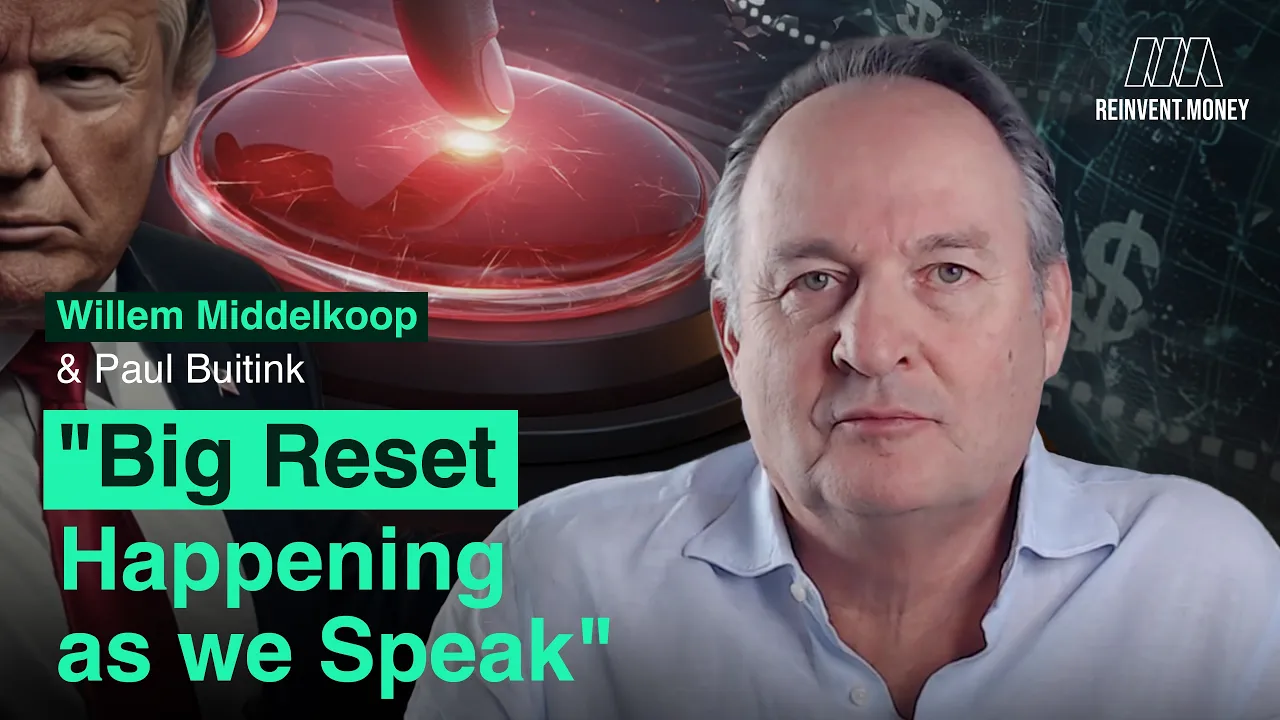
The Big Reset: Gold, the Dollar and US vs China
De Week van Bitcoin · 2 May 2026 · 55:49
Paul Buitink of Reinvent Money talks with investor and author Willem Middelkoop about the monetary shifts he calls the Big Reset. Middelkoop argues the world is splitting into a dollar bloc and a BRICS bloc led by China, and that change comes gradually rather than in one break. They discuss a Deutsche Bank report on gold returning to the system, central banks and commercial banks turning to gold, the petrodollar and the role of Saudi Arabia and OPEC, and how war risk ties into the fight over dollar dominance. He closes with a hopeful scenario of US and China cooperation.
Speakers
Topics
From De Week van Bitcoin; community: Reinvent Money.
Transcript
The bifurcation and the reset is happening as we speak. The US can't win a war in the South China Sea. Actually, the US never won a war after the Second World War in Asia. The US have said, "And reaction, we want to help you and we can help you, but then you should leave the the OPEC." I think now you're witnessing the start of the next wave for inflation and the interest rates. The major banks now reached a point where they can't ignore gold any longer.
I would be very surprised when we don't get a very interesting initiative by the US on the international monetary system or or especially on the dollar because it's quite clear something must happen. How can you bring trust back into the system? It's just bringing gold back into the system because that's what people understand. >> Hello everybody. Welcome back to Reinvent Money, a podcast about money and power. Today, I have my old friend Willem Middelkoop back on the show. He's the author of the book The Big Reset,
founder and chairman of the commodity discovery fund, and he's also known as the Oracle of Amsterdam. We're both Dutch, but we'll conduct the interview in English, of course, because most of my viewers are indeed based in the United States. Hi Willem, good to see you again. How are you? >> Yeah, I'm great. You know who invented the Oracle of Amsterdam? >> I think it was Max Kaiser, wasn't it? >> So that's I like Max, you know, he's one of the OGs. He's a very bright guy and uh um we did an interview twice Uh, I think 10 years ago after the big reset was launched, so he was standing on the bridge on the Amsterdam canal
waving the book and saying, "Read my the Oracle of Amsterdam." I like that so much that I I still use it. >> Yeah, I remember that. And we we go back a long time because around that time I also organized a big conference in in Rotterdam. You spoke there. Max Keiser was there, too. And I haven't talked to him in years, but I think he's based in El Salvador, isn't he? >> Yeah, yeah, but he's he's following me on X and his wife as well. Um, sometimes they like and retweet stuff, but Max is go well, he he he he he's he's not that um uh, that visible anymore.
>> No, no. >> I think they made a lot of money with Bitcoin. I'm quite sure. And I think for for safety and security reasons, uh, they keep a low profile. >> Right. Well, let's talk about the big reset because it was one of those defining books for me as well. Uh, yeah, you wrote it in 2014 with an update in 2016. Some of the things you predicted, amongst others, gold to breach $5,000, central banks to scoop up a lot of gold, uh, the dollar to lose dominance versus for example the renminbi. So, most of these things seem to have transpired.
Uh, maybe not in a big bank style, but more like in a gradual way, but still. Uh, so, how do you look back at your book and and and these predictions? >> Well, um, changes in the international monetary system always take more time. And I think on the back cover of the big reset I wrote around 2020 we're in for some big changes in the international monetary system. We need to find a new anchor for world's financial system. Gold will be reintroduced. Gold will be revalued. Uh, we might move from unipolar to multipolar world.
And but I I wrote it in 2012, 2013. It was published early 2014. But we are still looking into the fog, you could say. And you know which train you are in, you know which track the train was on, you know the direction it was heading, but there was still a lot of uh well a lot of fog, so you couldn't see where the train would hit the wall, so to say. And now after another, what is it, 13 years, it's quite clear that that main thesis um also that you can expect that
restructuring, the reevaluation of gold, move away from the unipolar world. It's it's all starting to unfold now, but but the monetary process and move to the next phase, the world's monetary system, it it's a process, it's not a binary event. Uh often investors, they they always want to see um things from a binary point of view. It's zero or one. It's black or white. But I always tell them you have a lot of shades of gray, and especially on these matters, things don't happen with a bang. Well, the Soviet Union collapsed with a bang.
Um but I was expected that we would see more gradual shift with uh less power for the US and the dollar, more power to to China and the East. And but what's particularly interesting, if you look at the epilogue, the end of the book, that I I wrote about two scenarios which could unfold. And uh don't forget that around 2014, there was a lot of international cooperation. We were we just we were one global happy system.
And and China China's renminbi was added as the sixth currency to the IMF currency basket. It wasn't till 2015. So at that time you could envision a move to a next phase in the monetary system as a joint effort from the West and the East together to make sure that we could move to the next phase without any serious fallout, without any serious harm for for the for the world's economy and and world's financial system.
But in the epilogue I I wrote I was hoping that we could work together, join forces, use the IMF, your use the SDR. But now you know where we are now, 13 years that a good 10 years later. We have this bifurcation in the world economy. We have a bifurcation in the trade system. You have the Western block trading still in the US dollar system, but you see the BRICS block led by China using other currencies. So the bifurcation and the reset is happening as we speak. And just this week Deutsche Bank published a very important report. I'm quite sure you
must have seen it. Because if you read that report, it's almost like an executive summary of the big reset. They say gold will come back into the system. Gold is coming back into the system. Gold will revalue to much higher levels. They openly talk about the next phase for international monetary system. They talk about the declining role for the US and the US dollar. I think the US dollar won't collapse. The US dollar will still be here in in in in one or two decades out. Look at the pound sterling, the British Empire isn't here anymore, but the British pound is still there.
So, don't think in these binary ideas, but just see it as a process. >> Yeah, I saw the tweet about the report, but I haven't had the time to to read it, but it sounds very interesting and and very much in line with what you wrote in the past and what you you and I have been advocating for many years now. So, in the past we had a few sort of those disruptive binary moments where it's 1944 Bretton Woods or the Nixon shock 1971, but if I understand you correctly, the we won't have such a like shock moment this time. It will be more of a gradual approach whereby several currencies perhaps
can can attain some sort of reserve currency status without one being dominant. >> Yeah. Yeah, so it is it's quite clear now for me it's quite obvious where we're heading. And oh, I I should I should come back to the epilogue because I wrote the positive scenario is we we join forces and we move to the next phase for world's monetary system, but the negative scenario scenario would be that there there would be a war. And I think I I wrote that they have mean wars for less important issues.
And now unfortunately, we're heading towards war. And if you get a war between the West who wants to maintain the current dollar system and the opposing sides being the BRICS led by China want to have a new trading system without using US dollar, you will understand that it's an existential threat for the US. So, all most of the current wars we see, whether it's in Ukraine
or in the Middle East, for me, they're all connected to this existential fight for the US and I've often tweeted that the US won't go down without a fight, but we we're in the middle of this fight. US Trump made quite clear that everybody who would support the BRICS would um be confronted with a very negative reaction by the US. And what we've seen in in in in the Gulf is that the petrodollar system, which has been around since 1974, um and was designed
to rescue the US dollar after a huge dollar crisis started to happen after Nixon took the dollar off the gold standard. And this petrodollar system started to break down a few years back when Saudi Arabia decided to do a deal with China selling them oil for um the renminbi or yuan, you so to say. And um you might remember um this video still be found on YouTube. I think this was in 2017, 2018 when Trump was in his first presidency. You saw a meeting of the OPEC and then Putin came walking into that big conference hall.
And then he saw uh Mohammed bin Salman, uh the well, effectively the the new ruler of Saudi Arabia. And and Putin and MBS, they walked to each other with the biggest smile and they gave each other high fives. And you could see Trump walking in the back. He didn't see it, Trump. That that that that was so telling. That was that was the moment, the watershed moment for me that it was clear that Saudi was moving to the BRICS camp.
And actually, around that time, BRICS was wasn't anything serious. Um But it >> the video well. This this bromance was was so obvious. But at the same time, I mean, there there there are no friends, just interests, right? Because also Saudi Arabia is is is is is in one moment they're cozy with this country, the other moment they're cozy with another country, just like India. They they they try to play all sides. What do What do you make of the UAE leaving OPEC and and and also not rolling over the loan to Pakistan, which then had to go to Saudi Arabia to to get the financing in place? It seems like the Arab nations are also splitting apart, where maybe UAE is joining the the Western camp and Saudi Arabia with more
focus on China and Russia. >> Well, for me, the most important development is whether or not Saudi's playing both sides. It was quite clear that Saudi wasn't just America's friend anymore. And since 1974, you know, that was a very strong connection. >> True. >> Um So, the power is shifting and I think um when a new war starts, like we've seen in the last few weeks, you always have these unintended consequences, the secondary and the tertiary effects. And that's what we're seeing now. So, one of the uh consequences of this war is because
they don't There's there are no exports anymore, virtually no exports anymore coming out of the Straits of Hormuz. So, these Gulf states get a liquidity crisis. They get a hard currency crisis. So, they contacted um the the US and the Federal Reserve asking for dollar swap lines. Well, I think the US have said in reaction, "We want to help you and we can help you, but then you should leave the the OPEC." Uh I think that was that was connected.
So, a few days after we got the news that they have these dollar swap lines with the Federal Reserve, you get the announcement, "We're leaving OPEC." A- and and who's who's benefiting? Uh the US because they always wanted to break up the OPEC. Um uh the oil price might move down a bit more, especially after this crisis ended because now the UAE is no longer held to the OPEC quota. The UAE can still increase their production a- and bringing the oil price down is of course a major goal for the Trump
administration, and that's also very harmful for Putin and Russia. So, this this is this is realpolitik. This is power politics. This this is geopolitics, and you see it all playing out, and it's all this big existential fight for the US to stay in control. The US actions against Iran and Venezuela are of course um also motivated because Iran and Venezuela deliver cheap oil to China.
A- and this is all a fight against China. So, to come back to the epilogue of my book, we're in the confrontation phase. It's not the cooperation scenario. It's the confrontational scenario, which might even lead to open war between the US and China at a given uh point in time. And And when you listen to the experts, they all point to, let's say, 2028, 2029, 2030. Um because the US also understands every year you wait, the Chinese uh army, and especially navy, are getting more and more powerful.
And And I I've I've done a bit of research, and if you look at the the war games and and and war studies which have been played around this topic, the US can't win a war in the South China Sea. Actually, the US never won a war um uh after the Second World War in Asia. They They lost in Vietnam. They lost the the fight in Afghanistan. So, we're in for a very interesting ride, but it's also a very scary ride. So, for me, it's no surprise that people are fleeing towards gold, actually.
I became convinced people would start to fly to flee towards gold when I was still a journalist. And actually, I stopped being a journalist in 2008 to build two companies uh centered around gold because I I was sure that people would start to flee towards gold. But then, we didn't have these geopolitical dynamics. This was just on the monetary debasement uh point of view. But now, even central banks will get a fifth year that central banks are buying more than 1,000 tons of physical gold on a yearly basis. This has never happened before. So, it clearly shows you shouldn't listen to what central banks say. Just watch what
they do. >> Yeah. Yeah, last year was slightly less than 1,000 tons, but the years before indeed 1,000 tons and this year I just saw that the first quarter was 244 tons. >> Yeah, around 1,000 tons again and just just well, if you could show the graph, it's so obvious that you've done an interview last week with David Marsh of the OMFIF of the OMFIF. I was at an OMFIF event last year where I was seated next to the gold guy from the Deutsche Bank and the gold guy from the Polish Central Bank.
And it's so obvious now that um these these guys they they understand what's happening out there there and they want to hedge their current fiat money positions their current um dollar positions. They they know we're in for a big change, we're in for some shocks. And any student of monetary history understands gold is the best way to to position yourself for that.
>> Well, it was funny because you and I both attended a very small scale event a few weeks ago and it was sort of for for you it was more common, for me it was the first time to join such an event with a lot of senior former central bankers and some top economists and they were all talking about how unsustainable the euro looks and how there's this need for a safe asset within the euro zone and you and I were looking at each other like dude you you just completely missed out on and they they know about gold of course because they're central bankers, but they just refuse to discuss it.
>> Yeah, the whole meeting gold wasn't mentioned until we it up and and this was an un-fifth meeting and the meeting I just described with the the Polish and the German uh central bank gold representatives, that was during an un-fifth conference in London last year and the main conference room was downstairs. That's what everybody was talking about well, the the usual topics. And then the gold breakout room was upstairs.
And there were just four central bankers who were responsible for the gold activities of their national bank and there were only three or four people in the audience, two being Chinese ladies. One from a Chinese sovereign wealth fund. And one from a Chinese bank. So that that was so telling uh uh even in London in the banking circles, gold is the 800-lb gorilla in the room nobody to touch and nobody wants to see and uh uh but but this report by Deutsche Bank, which is only two two pages but it it's it's it's wonderful and it shows that the major banks now
reached a point where they can't ignore gold any longer. They tried to downplay gold in the last few decades. Uh I always when I give a presentations, I always ask the audience who of you ever had a call by his banker that he should buy gold not your private wealth manager but just your normal traditional bank have you ever called you and said you should add some gold? No, it was the opposite. I mean many rich um people who sold their business and when I asked their bank here in the Netherlands
to add gold for 10% to their net worth, they they laughed at this and away. And I And that's why I build a gold bullion business. That's why you're in the gold building business because the banks they don't want to touch it because gold gold is the anti-dollar. Gold is is the enemy. But now we reached the point they can't ignore ignore us any longer. And another uh indication is that the Chief Investment Officer of Morgan Stanley, he put out the study last year that they moved away from the traditional 60/40 institutional investment portfolio where 60% is invested in stocks and 40% in bonds, and he changed it to the 60/20/20
portfolio, meaning 20% is they're advising their clients to put 20% of their net worth in gold now instead of 40% in bonds. And And they they cut their bond position by 50%, and that's that's the max they can do. They uh You can't imagine a Wall Street bank uh cutting their bond exposure to zero. >> Yeah, of course. Yeah. That would be politically uh not feasible. And those That was a watershed moment for me, too, that Morgan Stanley put out that paper.
And in Holland, of course, for our international viewers, they don't know these names, but in Holland over the past few weeks, quite a few big firms such as Achmea, Nationale Nederlanden, ABN AMRO, they all um put a positive notes about gold, how you should have at least a few percent up to 10% of your portfolio in gold, which to me was also like, okay, for these uh companies, big companies to to start um being positive uh publicly about gold means they they're up to something, right? They they want to cover their asses in a way that if things go really sour and they have not been able to properly advise their customers, that's neglect. That could also backfire. So, they have to start positioning themselves.
>> But I often I always want to step into my helicopter and go up to 30,000 ft and look back uh to to all these um changes and all these reports coming from the financial industry. And if if if you look from this bird's-eye view, then you understand this is this is the reset in process. Now, it's all starting to unfold now. And we we all know, especially as industry insiders, how small these markets are. Well, gold is still quite a liquid market, but compare it to the money There's There's over 300,000 billion invested in assets.
Around 100,000 billion in real estate, 100,000 billion in stocks, 100,000 billion in bonds. And then if you look at physical gold, that's a much smaller market, but then look at physical silver. You can't even see that that dot compared to the these other huge markets. If you look at the valuation, I'm I'm the founder of the commodity discovery fund. We invest in listed com companies who still discover new gold, silver, copper, uranium fields. And if you look at the valuation of all the listed companies in in our space, it's only a few hundred billion dollars.
So, it it's it's nothing compared to even, let's say, the Magnificent Seven. But if you look at the free cash flow, the free cash flow now for the gold producers, it's it's almost as large as the free cash flow of some of these Magnificent Seven. And And with the Magnificent Seven, the tech stocks, you see the free cash flow coming down. And And with the precious metals producers, you see the cash flow going up. So, soon they might cross, but the valuation is still I think it's it's 1% of of the valuation of the tech companies. So, that's we're in for a huge revaluation. This has just started.
Even gold and silver, which have a technical correction now, I think will go much higher, especially silver. Don't be surprised to see three, four, $500 silver. Might be even conservative. Not next year, but let's say around 2030. And we do a lot of supply and demand studies. If you just focus on critical metals or uranium, they all will be in short supply after 2030. Or we need a worldwide recession or depression where we have demand destruction. But if there's no demand destruction and we keep getting more currency debasement, um
uh many investors will start to join the flight towards hard assets that all the governments can't print. And and then you could have a boom market, which will even be stronger than the boom market which we seen in the 1970s, which was a wonderful boom market for for for gold and silver and hard assets. So um it's all starting to unfold now, but we're very early in the game. >> Yeah, which I one chart I find fascinating it's it's on your website on cdfund.com. I'll put it in the in the video. It shows uh the commodity index versus the Dow Jones Industrial Average, and you can
clearly see that we are in in in in a in a in a phase where it's it's very much undervalued commodities. And if you look back at the '70s or or wartime '40s, like a lot of these periods are similar to what we're currently experiencing. Um and and then the valuations were much higher. So, it if you look at the chart, it it looks like we're we should be getting into um that phase soon where where the the value of commodity companies is is appreciated in the right way. Um >> Yeah, that that that graph shows the valuation of let's say the commodity index compared to the Dow Jones.
And because the Dow Jones keeps rising, even if the commodity prices start to move up, the ratio still Right. record low. And and we all know everything is a cycle, you know, every single financial cycle is financial markets, but also in nature, in science, everything is a cycle, you know, light, energy, it's it's these all cycles. So, you go from o- overvaluation to undervaluation. The last time we had overvaluation in commodities compared to the general markets was in 2008. That was the start of >> the fund.
>> Yeah, right with the situation to start a commodity-based fund at the top of the last cycle. So, we had to endure 15 years of bear market. And actually the bottoming pattern started in 2013, 2014. It's now 10 years later, we're still ending the bottoming pattern. We're just moving up. We're inching up from a very low base. So, that means the reversal to the mean part still has to unfold. Then you get the overshoot towards um overvaluation, which is typical after a very strong undervaluation.
And that's the technical uh well, that's the technical image. If you look at the fundamental image, I told you we do the supply and demand studies. From a supply and demand perspective, you can expect real shortages in some of these metals. Now we have production deficits, which means production can't keep up with demand. Will mines can't keep up with will demand, but we still have above the ground stocks available, so there are no physical shortages. In these energies complex, you see the same now because of the Gulf War, there's not there's a production deficit now, it's 10%. We lost 10% of oil production, but we don't
have real shortages yet. But now the first countries are starting to warn that in a few weeks or even a few months, you'll see real shortages in jet fuel or diesel or whatever. And that's when things get very interesting for investors because as soon as you reach the point you get real physical shortages, then you get the real fight for the last commodities available. And then the only way the market will get balanced again is demand destruction because due to much higher prices.
>> Right. >> have to move to a level that you get 10% demand destruction. >> Yeah, exactly. And I can also imagine that because of everything that's going on in the future, governments, companies, they would like to have higher stock piles. So you will probably see a a extra demand the next few months, years. So just like you see already in Europe with with our gas supplies that we want to have stronger supplies just like China has at the moment for example. You saw that's going to add also to demand going forward.
>> So these these are the longer-term effects. Even if you get peace tomorrow, even if you get reopening of the straight tomorrow, the longer-term effects will be huge. Just like we seen after COVID. COVID took a while, but then the markets and countries opened again. But but the longer-term effects of COVID was of course a breakout of inflation after a 40-year downtrend of inflation and interest rates, we had this huge spike higher.
That was the first wave of inflation. We had a correction in the last two years. Rates came down, but I think now you're witnessing the start of a next wave for inflation and the interest rates. And Jamie Dimon, CEO of JP Morgan, is already warning um um that that the next credit downturn could get real serious. And he has been warning for a sovereign debt crisis or a bond crisis. And when you get a bond crisis in one of the major economies, let's say Japan, the UK, or the US, what will central bankers do? You know,
they only they only can print more, but then the problem gets worse. So, we're in the easy part of a new phase of a new crisis. Crisis is developing on several fronts. It's It's developing on the sovereign bonds. It's developing in the world of energy and commodities. Uh it it's developing uh on the inflation side and and and so many people we service with our companies, you know, that's let's say the smart money, that's the independent guys who made a lot of money, who sold their company, they can go everywhere with that money.
And they they are starting to flee to everything the government can't print. And that's what we told the central bankers during the annual IMF meeting. And they don't want to hear that. They're They are aware of it, but they try to ignore it. That's That's another 800-lb gorilla in the room. They don't want to see it. They don't want to talk about >> Yeah. It's interesting the other day I went to a wealth management conference, and it was not attended by uh high net worth individuals. It was just attended by uh companies within the space that offer services to these people. But there was one high net worth individual that was invited to to be on stage and and share a little bit about how he invested. It was a young
guy because they also wanted to reach out to to the young wealthy people. And he was just saying on stage that most of his money was actually in gold and silver. It was so funny for me to hear that because all the other participants, all these private banks and and all these funds, they they also still try to avoid gold because they can make money out of gold. But their their clientele is actually interested in in in that stuff. And there's a complete mismatch between what they offer and what their customers want. >> You you know about my model portfolio which I use personally and I've been advising to people for over 10 years now. That's 25% in real estate. You know, that's a hard asset the government can't print. 25% in physical gold and silver. Hard asset the government can't
print. Then 25% in listed stocks. Preferably with good assets like the commodity companies. Uh even those are hard assets government can't print listed uh equities. And we know from hyperinflation like in the Weimar and Zimbabwe or Venezuela, stocks will do very well in hyperinflationary scenario. And then I will say keep 25% very liquid. But you can buy Bitcoin which is virtual gold in my as I call it since 2014.
And if you buy Bitcoin, that's virtual gold which the government can't print. And if you look at all the scenarios, what can go wrong? You know, banks can close, stock exchange can close, you can get hyperinflation, you can get a a deflationary collapse. If you take all of these scenarios and you have this model portfolio, you always will end up with at least 50 or 75 or even 100% of your net worth during such a crisis. While most of the investors I talked to, they're all in stocks or they're all in real estate or they're all in crypto.
And and all these three bring huge risks. I I can show you examples that price of real estate in Amsterdam went down 80%. This happened after the uh during the times of Napoleon. I can show you examples of crypto going down 80%. It happens every 4 years. >> We've all we've we've all felt that, yeah. >> Yeah, I can show you examples of stocks going down 80%. So, always diversify. And if you diversify, these are uh the these kind these markets often have different cycles. If you study the Bitcoin cycles, another cycle than the
gold cycle. Um uh real estate is a wonderful market. I made my first money in real estate. I still like real estate, but it came down 30% after the great financial crisis even in Amsterdam. And when you use leverage, which everybody does, everybody has mortgage on their real estate. I know a story of two very rich brothers and they collapsed because the real estate came down and they were leveraged too much. So, you need this diversification and well, it's easy when you have a bit more money. I often get a question by younger people, yeah, but I only have 10K. What How should I diversify? I say sorry, that's a bit more difficult. I should
buy some silver, I will tell them because silver is still cheap. >> Yeah, as I always tell young people, look, you're young, you still have enough time to to compensate for your mistakes. Just focus on something, invest in yourself, start a start a company and you know, make mistakes along the way. Who cares? You're young. Really. That's that's and then the older you get, the more you need to diversify because you want to be able to to in in the end live from from your savings. Um you know, I'm I'm a small investor in your fund, of course, as you know, and and fortunately I I I bought at the dip basically. But the one challenge people sometimes seem to have with mining stocks is that there's always this risk of confiscation. Uh of course all gold bugs always worry about
confiscation because they refer to 1933 but uh stocks especially when it's concerns a mine that produces very critical minerals especially in this age of of you know, everyone is stockpiling um uh raw earth minerals and and all sorts of um commodities. How how How do you assess that risk of your uh stocks or the mine being confiscated or a permit being withdrawn? I mean, we do hear these stories often in Africa and also South America. >> The biggest risk when you have stocks is that the stock exchange closes. This happened in the past. That's the biggest risk. So, that's why I advise only 25% of your money in in stocks. But if you look at the mining companies uh of course, nationalization can
happen. I think we've invested in over 300 companies over the last 15 years. We had one nationalization. That was in Bolivia. Um and and it shows you should diversify and that's where why we have 60 70 80 positions in our portfolio. So, if something happens with one of these positions could be nationalization, could be a fire, could be a landslide. Uh sometimes mines close because of just one landslide.
And so, you should always diversify and many retail investors make mistakes because they want to buy these mining shares themselves. So, they have four five, six of these shares. And then one accident happens and then they just found find out they well, they invested in the wrong one. So, I always tell them, "Don't try this at home. If you want to invest in stocks, look for professional fund manager uh whose well, full-time job it is to to to to be sure you're you're invested in the right basket.
Um But but to come back to your question on a more general level, do I expect confiscations of gold mines? No. Um what I do see happening that you get special well, extraordinary taxes because the profits will become so high for these gold producers. And we see that already happening in in in in let's say countries in in Africa. Um and and nationalizing listed companies is the worst mistake countries can make because if you start
nationalizing companies, you know, you break down the basis of capitalism because once if you start by nationalizing gold mines, where do you stop? You know, then you can start nationalizing energy companies as well. So, that's the last thing la they will do especially in West Western countries. >> Yeah, right, because we've we've seen it in Zimbabwe and in Venezuela. As soon as government starts nationalizing companies, then output will fall and at some point dries up. So, but it may still be tempting, of course.
>> why we don't invest in Bolivia or we don't invest in in Venezuela. Well, Bolivia is is is seeing a change for for the better now. But there are certain countries where we won't invest, but there many countries, even in West Africa, where we have very profitable investments and where you can still do business. But we are not in Mali, we're not in Chad, you know, there's the these countries where you know you'll get you will get problems. But if you're in Guinea or Ivory Coast, there might be a military coup, but on average, mining business, they just continue to produce, they just have to send their taxes to another world port.
>> Yeah. >> That's that's the way it is. Talk talking a bit about Africa, and maybe also going back a little bit to um the discussion between the US and China that we had earlier. Um because all of these different conflicts, whether it's Ukraine or whether it's Iran or all these um uh turmoil in in Africa, it it it all it's all basically it all boils down to the greater conflict or the greater potential conflict between the US and China right? >> Yeah. Well, that's that's my take, and um and and and that's that's the same reason why I want to step into the helicopter and go to the 30,000 ft level.
It it if you want to analyze uh where we are, um where the world is heading, it you make it so much easier for yourself to have this bird's eye view and to see the broader picture. And what I always learned that investors, they hear so much news on a daily and hourly basis, but they forget they don't see the forest for the trees, you know, they they're always distracted by all these uh events happening, and I try to focus on the bigger picture.
And the bigger picture hasn't changed for me in the last 20 years. Um and that has helped me um a great deal. >> Yeah, you've been very consistent in in your message. Um so you talked about an existential threat. That's that's how the US sees it. We now see this military build-up in the South China Sea. We see Japan, the Philippines, US, Korea, they're doing these exercises. At the same time, we see China building up its military strength there. I mean, that that could easily go wrong, right? And for whatever reason, and that could then lead to the big great war between China and and and the US. But, they both are armed to the teeth, also with
nuclear arms. So, talking about existential threat, it would be an existential threat not only for them if they engage in in battle, but for the whole world. So, they must also realize that, and perhaps that will hold them back in the end, or >> Well, I'm always to calm down investors because if if they start talking about the risk of nuclear war, you don't have to worry for nuclear war because if it starts, it doesn't matter anymore. It's too late. >> very comfortable with this message.
>> No, but you know, you don't have to worry about your investments in a nuclear war, nuclear winter. >> They're gone. >> You know, they always say an optimist buys gold, a pessimist buys a gun and canned food. Yeah. So, and if if there's no nuclear war, there hasn't been any nuclear war ever. Well, the US dropped two bombs to to show the world they were capable of doing so, but this wasn't a nuclear war between two countries shooting nuclear warheads to the other countries. So, if we get that, you know, it's too late. You don't have to worry anymore.
You'll die. Probably we'll die. And if there's no nuclear war, you mean worrying about something that never happens. So, forget thinking in in those very negative scenarios, but I try to learn people that um they better prepare for a further debasement of the currency and look at the graphs. Incrementum showed these great graphs in their annual Swiss Trust Report. Look at Look at the loss of purchasing power of all fiat currencies over the last 50 or 100 years. You know what will happen.
Lebanon is experiencing hyperinflation as we speak. Uh Turkey The Turkish lira lost 99% of its purchasing power since 2000. So, these are the real risks. But because it's it's it's slowly moving, people tend to focus on these um on these Well, let's say the nuclear risk. I I I We had a few investors here always afraid for all kind of risk. And one of them, he died in a motor crash, you know, stepping on his motorbike. That's the biggest risk in his life. The other fell down from the steps in his basement.
So, Yeah. Thanks to to um to focus on on on on risks they shouldn't put too much time and energy in and focus a bit more while they're driving their car or their bike. >> Yeah, and then live your life. I I have also quite a few old customers, 80 plus, very wealthy, and still they're constantly worrying about everything like >> Yeah. >> Uh it's just try to enjoy life. >> Yeah. Well, I always tell them diversify, make some good decisions, and then you can forget about it. Maybe once a year check.
>> Yeah. >> Step into the helicopter, take the bird's-eye view again, and decide whether you need to change anything. >> Yeah. And then we didn't discuss it yet, but I I I sent you a message yesterday that I was I I saw a a tweet or like a truth post by by Trump like a few weeks ago talking about the the total reset and the world's most powerful reset. So I directly had to think of you despite Klaus Schwab trying to to sort of popularize and and claim the reset theme, you were the first one to to put it in a book.
So when Trump talks about a a world's most powerful reset, what does Trump mean with that? >> Now, of course he he read The Great Reset the night before. Now, all jokes aside, before um I published The Great Reset, the term reset wasn't used a lot. Well, it was used for computer resets, but it wasn't used for let's say a like a system reset. And and I I think it's it's too much um all merit to to say that I popularized the term reset. Klaus Schwab wrote The Great Reset. Many people think I wrote The Great Reset or uh so there's a mix-up, but the reset term is used quite a bit
uh in the last few years. And I saw that social through social post by uh Donald Trump talking about this will be the the major reset. And I think it tells you a bit that we've heard a lot coming from Trump and the White House, but we still haven't heard what his master plan is on this huge crisis which is called the sovereign debt crisis where the US national debt is almost 40,000 billion.
It's growing by 1,000 billion every 30 days. and something needs to be done. >> Like Hank Paulson said also, right? The other day that the the former finance minister you you tweeted that video. So he he's got he's coming out as as one of the main profits now worrying about or warning about the end of the road basically. >> And that's telling because why we haven't heard from Hank Paulson who was the Secretary of the Treasury during the great financial crisis. We haven't heard from him in 10 years. So why is he suddenly starting to warn? Why why is Jamie Dimon starting to warn?
These guys understand that within 12 to 18 months you might see big changes coming from the White House. And next year it's the 250th anniversary of the independence of the US. And there's some rumors that they might like to introduce a gold-backed bonds or they might want to do something with Bitcoin and gold revaluation of gold.
Um these are all rumors. But I would be very surprised when we don't get a very interesting initiative by the US. Uh on on the international monetary system or or especially on the dollar. Because it is is quite clear something must happen. And I was a bit early so I when I wrote around 2020 we we can expect big changes.
Um that could well be next next year. >> Yeah, but that would then apply only to the US and its vassals. It's it's so that's that's where you get the bifurcation then perhaps that the West would be trading with with with a re re devalued dollar and a revalued gold back dollar for example and then you would have the East having a renminbi kind of set up and then at the top you would have gold clearing all these transactions between the blocks or something. >> Well, Trump also tweeted a few years back he who has the gold makes the rules.
>> True. >> And that's that's a quote I used in my books very often. So it shows Trump read the books now. These are These are very um in the world of geopolitics that that line he has the gold makes the rules is very well known. And during presentations I often said I I'm curious who will who will play the gold card first? Will it be China? Will it be Russia or will it be the US?
The US could play the gold sheet card first and actually uh you can download the big reset for free at our website and it's one of the scenarios I put down in writing there that the US could revalue gold and then devalue the dollar. That's what they've done in the 1930s. >> Yeah. >> They um they called on all US citizens to hand over their money for $20 pounds and then when they had all this gold they built Fort Knox and they revalued gold to $35 and later $44.
>> So >> Yeah, so every time when there's the the whatever it is 1933 or 1944 or 1971, every time gold is involved when it comes to resetting the system. >> So when especially in times of crisis so we we know for sure we'll end up in the sovereign debt crisis. And and you get into a sovereign debt crisis because people lose trust in fiat currencies and in sovereign bonds, and how can you bring trust back into the system is just is just bringing gold back into the system, because that's what people understand, because for 5,000 years gold maintains its purchasing power.
It's the old rule for 1 oz of gold, you buy the best suit in the world. Well, 1 oz of gold is $5,000 now. You buy the best suit, and and that does mean the same for 300 years. >> Yeah. Well, yeah, Keynes wanted to have uh the bancor uh in 1944, and that was uh that was a bit like what the IMF has with the SDR, but then also linked to gold. Bancor, of course, means in French uh gold bank. So, perhaps something like that we could see in the future. But then that would that would require coordination amongst nation-states, and at the moment your scenario is more more likely, where there will be more confrontation instead of coordination.
>> Well, what's interesting is that Trump will visit China. And I think it's it's planned for May, next month. And I wouldn't be surprised that somewhere down the road US and China understand that it's better to join forces again. You know, um Trump has this quite special character where he loves it when he meets the real big guys, whether it's uh King Charles or or Putin, or even Kim Jong-un. But when he when
the Chinese, I think, understand how they should play Trump. So, when they give him all the honors, and and Trump can come back home and he says, "A great guy, and I had a special relation, and we understand we need to solve this crisis and that crisis. So, I wouldn't be surprised when something good happens while everybody is expecting a military conflict, a nuclear war. Uh in the end um states and governments and empires, they're there for survival.
And and the CCP, the Chinese Communist Party and see is his main priority priority one two and three is to keep staying in control and to avoid a revolution. And and the US priority one, two, and three is to to to keep the empire afloat. So, it it they might find some common ground somewhere. And that's well, that's my positive scenario and that's why I'm still smiling and >> Well, let's let's end here then and end it with with your positive scenario because I I also would like to uh
always address the positive scenarios too in order to avoid becoming too uh doomy and gloomy because when you're in the space like you and I are, there's always the risk of of uh also the risk of a bias of being too negative. And I'd love them to uh to come to deal that would in the end uh benefit uh would would be beneficial for the whole world. So, thanks so much Willem. People should definitely check out of course the CD fund.com uh more information about your fund. Uh full disclaimer, I also I'm a small investor. Um so, keep up the good work and and on X you're very proliferate as well.
So, I'll put a link uh >> Yeah, and we're open to new investors also from North America. We can even accommodate US investors. 50K is the minimum and well, look at our website. >> Good stuff. Well, let's do this every every and then. Thanks so much for your Willem, and I'll see you soon, uh, hopefully somewhere at an, uh, interesting event, uh, with some other central bankers involved. It'll be interesting. >> Okay, Paul. >> I have a good, have a good day. Bye.